
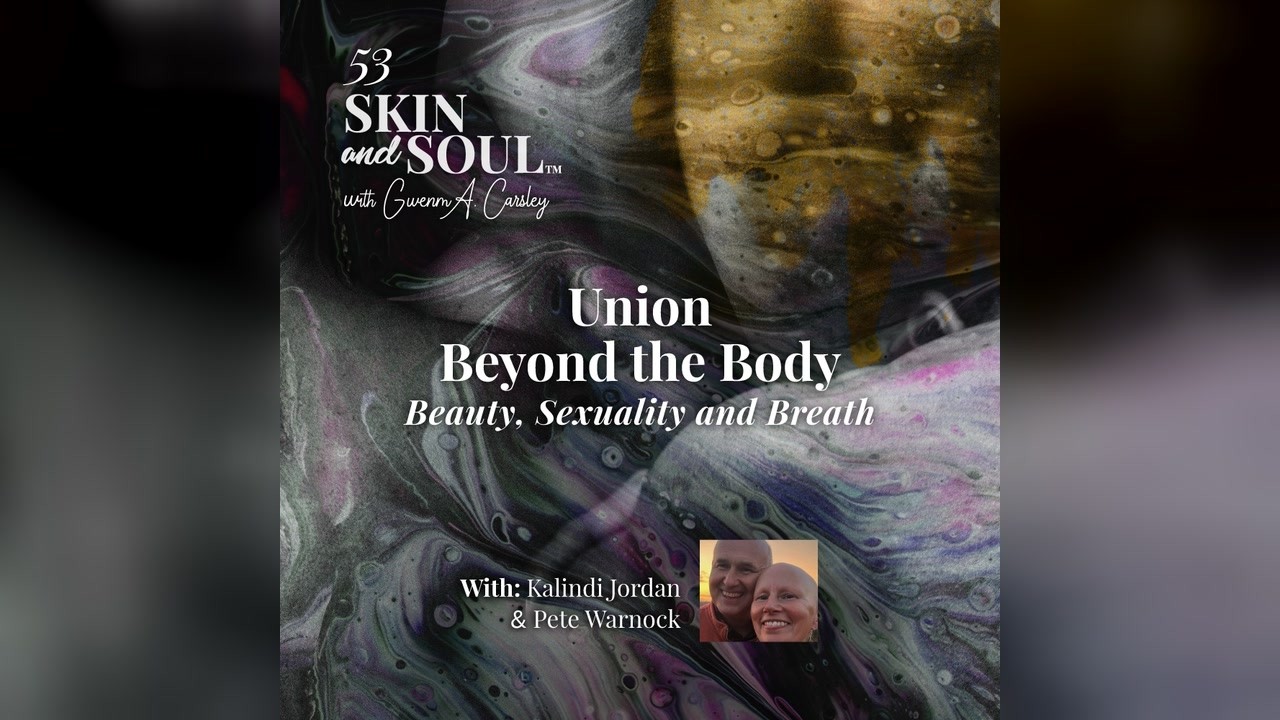
0:00 Welcome to Skin and Soul. I'm Gwenm Carsley, a transformational body, sex and soul coach, and I'm inviting you on a bold, unfiltered journey into the heart of our humanity through the lens of Eros. This is where we strip away the shame, dive into the unspoken and embrace the wild, raw truth of our desires. Together we'll crack open the taboo, uncover our deepest intimacies and awaken the pulse of our sexual essence. Because real transformation, it's messy, it's thrilling, and it's oh so delicious. Buckle up loves. Skin and Soul Beyond the Pale starts in three, two, one. Let's go.
0:38 Hello and welcome back. I'm Gwenm. I'm your host of Skin and Soul Beyond the Pale. And today I am so pleased to be joined by these two beautiful people. I've got Kalindi Jordan and Pete Warnock, who have been partners for 18 years, both in living, in working, in love. She's a sexual healer, an energy engineer, and an alchemist of touch. And she is a breath worker and founder of Naturally Ecstatic. Together they teach couples the art of staying and connection, and through living in love and their Amrita Tantra programs. So I would just love to dive in here because the two of you have had such a journey together over 18 years.
1:15 Congratulations. Congratulations. That's not a common feat anymore these days. There we go. Yeah. Yeah, it's great. Celebrating this. Absolutely. Yeah. Well, and I've heard Kalindi say that you put it out there that you were just like, I'm going to find my partner. This is, there's, there just needs to be one person out there for me. And you found him. Yeah, exactly. And I think also, well, hey, hello, everybody. Yeah. Just to, and also like in these 18 years, for it to feel so joyous and connected, and when we disconnect, our desire to find connection again.
2:02 And so it's, it's not like we're in these 18 years, like we're in any sort of deep, like we, we still loving it. And that's what I think I celebrate and we celebrate is that we work at staying, we work at staying in loving connection and going through the challenges and working through all the ruptures and repairing them as really well. So yeah, celebrating that for sure. Yeah. Because most people don't know how to stay together. And loving staying together. I think when people first meet, they, they, you know, we have all of those rose colored glasses. And because you teach Tantra connection, and Pete, you teach breath work, and I want to talk a little bit around the power of breath work, and say why breath work, as well as for the layman, what is Tantra?
3:00 Okay, wow. Breath work, first of all, you know, breath is breath is our, our kind of primary something. It's a primary happening when when we, when we get out of the way, then we are breath, you know, and actually the quality of our breath determines the quality of our living experience. And I just give a discover this really, really early on in my life through through injuries and accidents and stuff. And then just discovered just just how powerful it is and started playing with it and exploring it and and pushing my life into all sorts of and my breath into all sorts of extremes to kind of experience all sorts of different states.
3:39 different states. And realizing that actually, yeah, that when I change my breath, my state changes. And when my state changes in life, when I'm out and about in life, and something happens, and I have reactions and stuff, the first thing that changes is my breath. So actually, when we can when we can reverse engineer that and just check, keep consciously. Yeah, working with our breath and playing with our breath and bringing up our nervous system into a deeper kind of response to a deep relaxation state and a safety state inside, then magic starts to happen in our lives. So and that's woven through Tantra, you know, at the end of the day, Tantra is breath and awareness for me, you know, and then energy moves and yeah, it's beautiful. Yeah.
4:28 Then how does breath connect deeper connect you deeper with another person? Yeah, so one of the things that we quite early on, because we both been body workers for a long time before we met, and we were fascinated by kind of conscious inquiry. And so quite early on, one of our choices that we made, was, if we became dysregulated, or disconnected, or in a rupture of some kind, the first thing we would do is go, how am I breathing? It was like the first question that we needed to ask ourselves, how am I breathing? How are we breathing? Because we know that if communication and intimacy won't arise, if we're feeling dysregulated, out of centre, disassociated, in our survival brain.
5:22 So the first thing we have to do when something's not quite connecting is go, okay, so how am I breathing? And so that's when we would start to drop into first, like listening to the way our breath is moving. And of course, if it's really, really fast, then we're slightly hyperventilating, it's like it needs to slow down. You know, it's like we just change our state by the subtle changes of our breath. And so in a relational context, we use it a lot. And using it in a sense of like, oh, I'm not feeling connected to Pete. Okay, so how, what do I need to do inside myself first to drop more into my sense of connection, through my breath, through attention, so that I can work out what's going on for me, that's making me not quite connect. Does that make sense?
6:18 Yeah, totally. I mean, for me, my first intimacy is intimacy with breath, you know, and for me, breath is the divine. When I stop trying to do everything, I notice that I am being breathed, you know, it's not that I'm breathing, it's that I am being breathed. Breath is here, breath is the happening, the eternal happening inside of the body. Well, maybe not eternal, but it seems like it, you know. And when I bring intimacy to this, to breath, and just become so utterly fascinated and captivated by this happening, and really allow myself to love this, then, oh my goodness, that, yeah, that's the first step. And then everything, everything seems to flow from there.
7:06 So, yeah. It's funny, because you call her the bliss bunny, but I see the bliss in you. I definitely have bliss, yeah. It's taken more cultivation, for sure, with me, but yeah, yeah, yeah, absolutely. And that's why, I mean, my whole business, Naturally Ecstatic, is we are all naturally ecstatic just beneath the busyness, you know, but we spend most of our time up in the busyness, when actually this amazing wonderland is happening just underneath, you know, so. Well, and breath reveals so much. I, you know, I know for myself that, you know, feeling where my breath is at any one time, whether it's up here or sinking down, and just before I had given birth, I used to have one of those, what I would call my, the flat, flat stomach, right?
7:53 I could not expand my diaphragm. So breath was really difficult and challenging. And ironically, in giving birth, that, that space opened up. And all of a sudden, I found I could sing. All of a sudden, I found that I had more space to speak, that the voice naturally dropped. So I find breath such a telling experience of where, where you are, or where I'm at, in regulation or non-regulation. But the two of you do something beautiful, because you, you play together. Yeah, you do. Right? Yeah. On all sorts of levels, you know, we play in all sorts of levels and all sorts of arenas, you know, which is, which is wonderful, you know, so.
8:35 I think one of the, like, you know, when we're working with couples, and one of the things that we've learned together is, is learning things together. Like, we go and explore things together, we go on courses, we go on workshops, we go and learn, learn practices, we go and learn different techniques together, so that we can come home and have a kind of common language of intrigue and interest. And so then we, and then we explore something for a good amount of time, we might come across a new, new exploration, whether it be through some kind of breath work or touch, or communication techniques, and then we'll do it for every day for months, and really get into things because we, we become fascinated by ourselves and each other and how we work together. It's a fascination.
9:28 It is. And we complement each other really well in that because Kalindi kind of gets a lot of the esoteric kind of downloads of it. And I, and I am really tenacious with the, with the tiny little, tiny little pieces of it. I, I'm a details man. I want to understand this tiny bit and this bit. And if I just change this little bit, then what happens? And then, and then we discuss it, you know, and we discuss it from what's happening in my body and what's happening as a physical something to what's happening in Kalindi's body as an, as an, as an esoteric something.
9:58 So yeah, it's great. It brings me to, in the, in the esoteric, well, and, and there's a couple of things here. One is that I had heard you say also that you are the one that you brought language to her experiences, which was, which was really interesting to me. There seems to be this beautiful yin yang space and play. And, and, and Kalindi, you had experienced a Kundalini awakening that lasted for years. I'd love to hear about that experience.
10:32 It's so interesting. It's, I'm quite, I'm slowly starting to talk about it a little bit more in recent years, because I don't know, I'm quite a private person, but maybe it's time, maybe it's ready. so this was, you know, in my twenties, I lived in a kind of meditation community and I fell in love with inner inquiry and meditation and internal meditation practices. And so I was doing a lot of internal, mantras from India actually. And I was, I had visited India in my early twenties and I was fascinated by the quality of devotion that the Indian culture has.
11:20 And that sense of devotion to self, but also devotion to nature, devotion to the mystery, to, to what might be the divine. And so my learning and my practice was what if I gave every emotion to the source of life? So everything I felt, what if I gave that inner circuit back to the source of life and life is filling me. And so there's this sort of giving and receiving of every experience. And my relationship is actually with the essence of everything. And through that, I started to build a lot of energy in my body. And this was, you know, in my early twenties, I'm 50 now.
12:04 And there wasn't much information about sort of, there wasn't so many books that you get nowadays. And I was sort of thrown in and I didn't know anything about sort of energy systems in the body or chakras or different things. And I just started experiencing energy moving in my body. And I think one of the key things that started to happen was, and for those that have maybe experienced Kundalini movement, for me, it started with a shaking in my pyreneum, the base in my pelvis. And it was a very, very visceral, almost like a little mini earthquake in the root of my body. It was like, you could physically touch my vulva, and you could feel it shaking and you could feel it moving.
13:03 And so my whole pelvis would start this rotation that was very visceral to me. And that would build and build and many things would happen through my body. And I would keep breathing, keep meditating. And then I would, I would sort of, it would feel like I would rise up and leave, leave through the top of my head. And I would go to places that I don't think bliss is even the right word. It was, I cannot describe those places in words. It was a profound union of different levels, different kinds.
13:47 And I would kind of, and I would kind of, and I would kind of come around a couple of hours later, and my body would be on fire. And this, and then I would have to integrate. And I remember I was in my early twenties, I didn't really understand a lot of these things. And, but from that journey, when energy rises so quickly like this, it basically, it kind of deconstructs, deconstructs what, what you think you are, who you think you are. So it's like Kalindi disappears and all the structures of Kalindi disappear. And then as I came back into more into my body, all the structures came back in.
14:32 All the personality structures. So I got to experience almost like the architecture of our personality structures from the inside as they were reconstructing themselves. So a lot of my skills that I have now kind of are rooted in these experiences that I had in my early twenties of what, what we're made up of. That's why I kind of call myself an engineer of some, an energy engineer. Cause it's sort of seeing things from the inside. I mean, there's so much to say about this, but there's a little taste.
15:11 And then when working with other women or couples, how do you bring this work in and how do you work together as a couple? So coming from that place, cause I was going to say, Pete, have you had those experiences as well? I haven't had the same experiences. I've had my own kind of set of experiences of energy, and of kind of experiencing different realms. I often pop into a space when I'm sitting with someone or sitting with a couple or, or actually when I'm, when I'm teaching where suddenly, I'm, I'm in a place of deep presence.
15:47 And then suddenly the room just starts changing color and I can feel the room changing color through my whole body and, and whoever I'm looking at their, their faces change and they change into all sorts of other beings and all sorts of things. and at first I went, when that first started happening, I was just like, am I, am I going a bit mad or kind of, and then, but I was never threatened by it. And, the more I drop in, if I focus on the phenomena, then I can make it happen more, but I kind of lose my presence.
16:19 But if I just really stay present with it and just let it happen, then, I, I go to an incredibly deep place of, of, it feels like a deep, deep recognition inside of myself of, of being in presence, you know? So, yeah. And I think, like how, how it informs the work that we both do. It's, I guess maybe just to come back to a question you asked about Tantra, I guess how I might describe Tantra is it's Tantra to me is an awareness, being aware of the ripples of all things, being aware of the effect of the way that our thoughts ripple out into our reality, our actions, our words.
17:09 It's, to me, it's that sense of, am I in a level of presence to that which is? And so we often think nowadays of Tantra as a sort of sexual path, but it's, of course, sexuality is just part of that, but it really, it's about the level of awareness. So if we think about it in relation to sexuality, it's really about an awareness of where am I when I'm touching my beloved? Where am I inside myself when I'm looking in their eyes? Where am I when I'm saying these words?
17:45 And that's not just transferable to sexual intimacy. That's referring to everything. Where am I when I'm cooking dinner? Where am I when I'm driving? Where am I when I'm doing anything? So it's a curiosity, a curiosity, right? When you were talking about the two of you keeping it alive for 18 years and really loving the journey and every part of it. It's, it's being able to stay with those moments and staying curious all the all the time. Sorry, so I interrupted. It's like simple, the simple things of like, when we kiss, am I am I knowing that this, this is like the first kiss?
18:29 I've not had this kiss before because this is this moment in this, however, we are in this moment. So it's like how, how do we bring our awareness to the fresh and newness of this touch and this kiss? And that's what I feel like a big part of Tantra brings. And so therefore it's not like you can't really fall into routine or, oh, I was just I'm not really here. We're doing this. Does that make sense? It's like this I am present to what is happening now.
19:02 I mean, what, what I see in the world with, with individuals and couples and groups and stuff is that often people are trying to achieve something. They're trying to get somewhere. And for me, that's completely the wrong way round. Actually, if I let go of, of, of trying to experience anything and just really deeply savor what is here now, right alive here now, then I'm just with the unfolding, you know, and being with the unfolding and opening to the unfolding and finding a yes to this.
19:38 Then this is this is Tantra for me. And, and I've, we've, I mean, we've been on so many courses and so many all sorts of different things. And often, often we see people teaching sexuality and Tantra as well, you can get here, you know, when actually, you know, when we're trying to get anywhere, we're, we're missing what is already here, you know. And actually what is here is the absolute miracle of life. We're on the crest of the wave right now, you know, and if we're trying to achieve something, then, then we're, we're missing, missing what is here.
20:15 So, and that's especially, especially in intimacy, you know, when people are either chasing orgasm or trying to, trying to make their partner have an orgasm or whatever that is, you know, and, and they're often doing it for the other or trying to, trying to experience something in themselves, but for the other, rather than actually, what is, what is this aliveness here? And, ah, and how, if I drop deeply into this and let this be magical, then what happens in me kind of co-regulates and helps happen in, in my beloved.
20:53 It's not like I'm, it's not like I'm doing something to make something happen for Kalindi. You know, we're both dropping into something, ah, that's just so simple, that is so profound. And when we do that, then, yeah, we, we, we become moved rather than being the mover. So, except we live in a world that's very ADD. Yeah, yeah, for sure. And being in the moment, and, and often those moments are not in a place of being in this, like, right, there's, there's usually so much bracing.
21:27 There's, there's so many layers to get through first before anyone is doing that, able just to stay with that. Yeah. Like, which you described so beautifully, just sitting there, like, I, you know, I can feel that with you, you're doing it. And then most people are just like, I, I think I'm. Yeah, sure. I mean, I, I'm very ADHD myself. And, and I, I've discovered that there are really simple, simple things that really don't take long to just drop beneath. I think it's the micro practices.
21:58 Yeah. Like one of the, one of our passions, cause we agree, you know, it, we, we, this is our passion. So we've been doing this all through our relationship and not, not everybody's got the time or the inclination to put so much into say a meditation states. And so a big part of our passion is how can we share micro sort of practices that people can do within their day to build up that sense of dropping into that sense of moments of presence together. What do we do to get to each other that are simple and regulating?
22:39 You know, for example, like transitions, like attending to transitions, say one's been at home and one's been at work. When one comes in the door, instead of it just being this kind of. So hi, love, hi, love. It's like, no, let's, let's actually really meet. Cause you're two people are coming from two different nervous systems, two different experiences. So even just giving five, 10 minutes to the quality of connection in that moment can make a real difference to the rest of the evening. Yeah. I mean, putting down what we've been doing.
23:16 Put down what you're doing and actually making some time to connect. It might be a little check in a cup of tea, a little dance, a proper five minute hug, actually dropping into being there in that moment can make a real difference to what happens next. And so these are the things that we're very passionate about supporting couples in creating. And we do, we love the little micro practices because when we, because they're so simple and so quick, then we can do them anywhere, you know, and actually the more we do them, the more our body trusts, you know, and the more we build this, this level of, of, of kind of, it's like a muscle memory inside that, that when we do this particular breath, the body knows we drop, you know, or when we, when we do this, then, then the body drops.
24:07 And so we're all about kind of cultivating throughout our day, you know, I mean, we see foreplay as, as a whole day kind of build up, you know, and just kind of the way we look at each other and the way that we connect with each other and we just juice each other up, you know, and just, just because it's, it's really, it's a really beautiful thing to then, because if people come together and suddenly they want to jump into sexual intimacy, you know, that's a really hard thing to do.
24:35 You know, it's a really hard thing to do because there's a whole backlog of, of their day and, and all sorts of other things. So, I mean, yeah, we, we, we love to have practices that kind of, that, that kind of chip away at the day to day and, and all of the different backlog of all of the stuff so that we can be as present with each other as we can. And I think by doing that, you also stay with a person as they grow.
25:01 As one of my questions to you is, you know, as, you know, over 18 years we change and a lot of things happen. And so when you look at each other today, you know, what are the versions of yourselves that have changed and shifted? Good question. Oh my gosh. I mean, definitely bodies. You know, what was I like 32 and now I'm 50. I'm postmenopausal. Yeah. I lost my hair. I've got alopecia universalis now that happened six years ago. You know, I, you know, just such diff, just body changes in that amount of time.
25:47 And I think, I think one of the things that I really honour is that we, we actually talk about it. We talk about it. We name it. We grieve together. We acknowledge it. We go, oh, you know, and it's not like, it's sort of like acknowledging, oh my God, I got more cellulite. And it's like just acknowledging my grief and Pete honouring my grief of that. And also it's somehow coming into that. It's not denying that that's happening for both of us. There's something about going it and it's okay. And it's like, love isn't about the way we look. And of course it affects something.
26:37 We're not denying that we're indifferent, but we're journeying together in that difference and acknowledging those moments of grief when he grieves his body or I grieve my body, you know? So, I think that's one of the things that came to mind when you asked that question of, you know, changes. Yeah. And, and, and, and it's interesting because the, the Kalindi that I, that I am in love with, hasn't really changed, you know? it's, it's, it's not the body, you know, and it's not the personality, you know, we, when we met, we had a series of kind of really deep remembrances of each other on a kind of, on a much, much deeper level.
27:26 and that, that whenever we really drop in, that is, that is there for us, you know? So the bodies that, I mean, yeah, the bodies are great fun, you know, absolutely wonderful stuff. and, and, I mean, I would say, I would say that, yes, my body's got older and, and a little bit flabbier and all sorts of things. And the depth that I go to in it, you know, it has, has gone so much deeper, you know, my experience is so much more, you know? So, yeah. So, yeah.
28:03 Yeah. And I think also like for us, because we've both, got sons from previous partnerships and our sons are now adults, left home. So we've gone through that phase of, bringing up our children together and then them flying the nest and going into their own lives and, and supporting them both in that and feeling that, that kind of empty nest phase as well. And, recognizing all the feelings about that as well. And going, what do we, who are we now when we're sort of changing in those parental roles, and navigating that as well.
28:47 But I, I think the key is always acknowledging those sort of rites of passage in a way, talking about those rites of passage and saying, I, this feels, this feels like this. It feels spacious. It feels different. I, what do we miss and what do we want to do now? And who am I now without that role? You know, and also my, myself, I'm now a grandmother of two beautiful grandchildren. Congratulations. Thank you. You know, and, you know, there's just, that changes something again. It's like a whole nother initiatory phase. And I think, I think creating a real passion for creating the safe container to really communicate all the feelings.
29:45 Even if the feelings are passing by, they're not fixed. They're not like, this is what I feel all the time, but I have a feeling of this. I grieve this, or I'm worried about this. Or let's acknowledge that this transition has changed this for us. You know, this means that, you know, we, we had some plans to kind of maybe go live in another country for like a year. And then I had some beautiful grandchildren. So it changed those dreams. And we were like, okay, well, let's name it. What are all the feelings about that? You know, so I think, I think one of the keys is how, how do we create a container of safety to be able to say everything and anything, but know that it's not fixed.
30:36 Yeah. It's just in this moment, I just need to say this. I just need to say this feeling. Yeah. That's an incredible amount of trust, right? Trust and safety. And having done the work within yourself to be able to see where, you know, what's challenging you as you move along. So what do you think today, some of your greatest challenges are maybe now with where you are now, even to name? Yeah, I think, I think some of the challenges maybe are, I think, I think the AI world actually is changing something in the nature of our work.
31:23 You know, because I think a lot of people are starting to use AI as a coach, you know, like asking AI questions and things. And I think that's changing the nature in what, when people reach out to working with someone in person, I think that's an element of changing. And I'm also aware that that has its limit, you know, because AI is only going to have a certain level of intelligence until we need that nervous system somatic exploration of another. So I think that's something that we're, we're noticing in our work, you know, and some, some people that I connect with, I maybe worked with five years ago, they, they're like, Oh yeah, I've just been using AI as a coach.
32:17 And then they get a bit stuck and then they're like, actually, I need to come and work with you. I need an actual human being. I actually need a human being like to just, who gets what it is to be human, right? To get stuck that feelings don't make sense. They're not logical. They don't actually need to be fixed. They just need to be felt and expressed. So I, but I think that I'm hoping that phase won't be so long in the humanity that whole. and I think also, I know you, do you want to say something?
32:52 I mean, I lost my thread. One of the, one of the things that I see, it, that challenges me, but I see challenging everybody who I speak to is just the speed of everything nowadays. The amount of things that we, that we do in a day and the amount of things that there are to do in a day. and just, and the lists are getting, are getting bigger and, the pressure is getting more, you know? and, and I see that as, as, and book, I personally perceive because of that, there is so much more neurodiversity coming out.
33:27 And I, I see that that is actually because our nervous systems are just under so much more pressure than they, than they would. I know for myself, running a business for 30 years, I know that, when I was first running a business, I, I know I've always had ADHD or I know I've always known that, that there's, that there are, there are things going on that I, that I wasn't able to do within my office and stuff like that. but I know that that is a lot worse now.
33:55 And I really believe that it's because of, of a screens and B because of the speed of everything and the amount we have to fit in and to, to run a business, you have to do so wear so many hats nowadays, you know? Mm-hmm . So I think people are actually getting really, really squeezed. And because, I mean, as Kalindi said, AI, because people get answers so fast and they're jumping around from this thing to that thing, they've got answers for this, that, that, that, that.
34:21 Suddenly they're so full. Where is the integration time? You know, how do people make time to just stop and listen to the birds and look at the nature and just, yeah, drop. So I think, I think that's one of, one of the problems that, that, that, yeah. And, and we kind of, we, we come and go with that, don't we? You know, sometimes we make time and sometimes we, we're just too busy, you know? We get lost in it too. Yeah, absolutely. Yeah. Well, it's the part of coming back to sacred sexuality or human touch, energetic work, breath work.
34:56 It's coming back to being in the body. Yeah. And also, you know, AI, technology in general, as we know, as you just said, you know, it fills us, but it's not, we need human touch. We need human connection. Yeah. We need that, I think, eventually to survive and thrive. So, yeah. And we're kind of walking into this new era. I did want to touch on something which was just around in, in coming into aging, right? And changing those bodies and noticing, slowing down, noticing the change of the body and coming back into connection.
35:41 What are you discovering now as you get older? Because you said that kids have, you know, left the, the empty nest. And, and I also wanted to touch on beauty because there's something that I heard you say, because particularly women are really faced with the ideals of beauty, which are usually have always been touched up, airbrushed, and now even more so than anything. And coming back to that idea of essence. You know, you said you fell in love with her. Just from essence. Yeah. That's what I, yeah.
36:14 You know, it's like still seeing that. So. Yeah. I mean, Kalindi, Kalindi's never worn makeup, you know, when her hair first fell out and she tried wigs and she tried to put on makeup and stuff like that. And it was just like, don't do any of it. You know, you are so beautiful as you are, you know, and, and for me Kalindi shines through her eyes. You know, it's kind of, I, I, I perceive such a reality, such a realness when I look at Kalindi, you know?
36:44 And yeah, I, I, I've seen it so much. I mean, especially with, as, as social media and all that's come in, there is so much kind of people looking at others and judging themselves, you know, and so much more so since, since all of that stuff, social media and stuff. and yeah, how, how does one come, how does one come behind that? It, I mean, for me, again, it comes back to just really deeply dropping in and, and, and nourishing oneself in the moment and just really, really allowing ourselves to enjoy being how we are and what we are.
37:24 You know, it's, it's, it, again, it's, it's simple, but it's not easy. You know, it's all of these things are really simple, but they're not easy because we're so conditioned and we see it everywhere. You know? So. I wouldn't say like, okay, so I've got cellulite, you know, I've got cellulite, I've got this, I've got a little bit of flubber. And the thing is, the body does some amazing things, in its, in its wisdom, in its older, in its squishiness, in its, changing. And all of a sudden there's a deeper understanding if you, if you've been going there and allowing yourself to experience it.
38:02 Yeah. I think one of my, cause I've worked a lot with women and so beauty comes up as a huge theme. And one of the things that I peel us back to is beauty is an inside job. Mm-hmm. Like beauty is a relational experience. So it starts from, it's like, first it's like going, okay. So, okay, might have cellulite light on my legs, but how do I feel in my legs? Am I in there? Cause this body is, is, therefore this is our vehicle of experience.
38:45 So how can I first feel the relationship with my body so that I can get enjoyment out of the senses? And I'm, I'm so aware that there's many people in pain and there's different things. So I'm not denying the journey of that. And first the journey of beauty is, am I first in a relationship with all the parts of my body? Am I in a relationship with my smile? Am I in a relationship with the way that my breasts feel? Am I in relationship with where, where my belly feels?
39:23 Like, cause everything's in service to the experience, right? And so first that's where I start. Like, can we be here? Can we stay here? Can we enjoy the movement in our body and the experience of our body? Cause that's where beauty starts to grow. And then we start to be able to, it's not so, it takes away, we start to give more energy into that part of ourselves rather than when we look in the mirror and go, oh my God, they've got this spot or this, you know, whatever that is.
40:03 And then when we look at all those judgments that we have, we start putting a lot more energy into how do I feel in my body when I walk down the street? How do I, what if I wear things that make me feel great? The texture of clothes. What if I think in a different, in a way that brings a feeling of beauty? cause I know for myself when my hair fell out six years ago, I think the biggest thing wasn't so much what other people thought of me.
40:32 It was the inner judgment of looking in the mirror and going, oh my God, I'm so ugly. And it was so heartbreaking. And I was like, I don't actually want to live a life where that is what's going on inside my mind. Like I'm not, I, I, I'm here. I want to live an enjoying, enjoy for life. So first I've got to repair this rupture inside myself. So I sat in front of the mirror every day for at least 20 minutes, half an hour. And let all the different thoughts and all the different parts of me have their say.
41:11 And all the feelings, all the tears, I cried and cried. But what I was getting to was I'm just me. And I feel good in my body. I feel in my face. I feel in my, I just touch my head. And can I stay in my head? Can I stay in my body? Can I stay with it? And beauty then arises from that relationship rather than looking and go and, and telling that. It's like peeling away that thought. And, but becoming the being, the feeling of it.
41:48 And taking pleasure, isn't it? You know, can you take pleasure from these sensations? Yeah. I mean, a lot of the work that I do is around de-storying our sense, our feelings and, and coming back into pure sensation. So taking away the emotion, taking away or coming into the energy of the emotion. And the energy of emotion is always just life, you know, but it's wrapped up in a belief and it's wrapped up in a judgment. And when, when we can actually let go of that judgment and become so deeply fascinated with the energy.
42:19 And how does this feel? And what happens if I take this in? And what if I wear this? Then something magical starts to happen. And when I choose to take pleasure from it. And it's all about where am I perceiving this from? Am I, am I opposed to something or am I welcoming it and enjoying it? Because if I'm opposed to it and if I, yeah, if I react to it and reject it, then I suffer, you know? But if I just take it in and let go of the story and the meaning and just meet the life of it and just keep letting the life nourish me, then something beautiful happens and I free myself in there.
42:59 So. Because beauty really is, I think, it's amazing how you can, somebody can be invisible. And then as soon as they start to express and feel into themselves fully, how they begin to radiate. So, first of all, I just want to thank you, Kilini, for that beautiful gift that you just said. And, and also, Pete, I wanted to ask you, do you think the same is true for men? Having. I do. I do think it's the same as, I mean, I think it's less talked about.
43:33 but there is, I mean, there's a huge, there's a huge amount of, of kind of, I think bravado is also kind of wrapped up in the beauty piece as well, you know? and, but there is still a lot of, a lot of, yeah, there's still a lot of that goes on. And, and, and the answer to that is exactly the same. I think, I think in its essence, it's the same for both of us, you know, for, for, for masculine and feminine. and of course we both have masculine and feminine inside of us anyway.
44:07 So to actually meet it, we kind of have to weave through, through both the, the doing and the non doing, you know? so yeah. Yeah. And I was kind of, I was, I was thinking more on it, like, because of socially women have been very conditioned in a way that men tend. I, and I know that men have their own, social constructs. So I was just really curious about how men view their bodies, you know, as, as, as age, as we age, as we all do.
44:33 noticing the different and the, and the challenges. yeah, I still think it's the same. I mean, yes, everybody, everybody kind of ages and everybody, everybody, everybody's relationship with their, with their body changes. And, depending on where, again, depending on where we're looking from depends on, on what we see, you know? So, yeah. I think there's something about, it's almost a bit like the same as presence. It's like sitting in the, sitting in the point of our timeline that we are in, like accepting, I am this age.
45:23 I have been 20 and I have been 30 and I have been 40 and I have been this. And there's something about, and I think this goes for any gender, just the sense of, here I am. And while doing that, there needs to be an honor of grieving. And, you know, as a post menopausal woman and menopause being such an initiation for women and, and not just physical changes that, can be very strong, but the psychological changes and that midlife age for anybody, it's a review point.
46:06 It's a point where we kind of all pause and go, what have I done? What haven't I done? What have I achieved? What is, what is the harvest time where we harvest everything and we go, what is going on? And in that there is a huge amount of acknowledgement and grief, I feel. And, and I think there's a real key to go. I am this, I am this age. I've been all those. I don't need to try and be 20. I don't need to try and be these.
46:38 And I, when I noticed people really sinking into where they are in that age timeline, free, a certain freedom comes because one is not trying to be something other. And so therefore the pressure on the body to try and be something other than I am this. I'm not saying we shouldn't look after our bodies and stay fit and healthy and eat well. And there's so much we can do as so much information nowadays and so much love we can give our bodies. But there's something really powerful about going, I am this.
47:10 I'm very freeing actually. I mean, and there is that and, and I, I mean, there's lots of times when I'm in a place of, when I'm in a place of joy, whether I'm, whether I'm teaching, whether I'm at someone else's course, whether, whether we're, we're dancing. And I noticed that I just, I don't feel an age at all. You know, I, whoever I'm hanging out with, I feel like I'm just there with them and I feel like I'm the same as them. I feel equal and I don't feel there's any difference.
47:49 And often, often I'll have conversations. I mean, I go and see my son. He's, he's 22. and, we, we'll play cards or something like that. And I'm in the room as a 22 year old, you know, I don't feel, I don't feel this, this kind of divide at all. And I don't know whether that's just me or whether that's, that's how other people feel as well. I know that you have to have a similar thing, don't you? So, yeah. Yeah. I'm just going to transition into the, you know,
48:18 transition into my 10 questions. Ooh. So, if you're ready. Ready. Let's start with, hmm, what am I starting with? E. What is one truth your body has always known that your mind took years to catch up to? that, that love is always here. Love is always here. Yeah. Thank you. Kalindi. Could you say again? Yes. What is one truth your body has always known that your mind took years to catch up to? Hmm. My body really loves me and loves my experience. That it's in honor.
49:07 It's in honor of my experience. It's loving me. Yeah. Hmm. Right. that it's it's it's like being made to by being made love with by the divine that was completely non-sexual and yet completely everything you know utterly beautiful thank you lindy what is the most intimate moment you've ever had that had nothing to do with sex oh my god i guess i have had quite a few we could do two i mean one that's coming to mind is just a moment of being deeply immersed with a river and just falling into the trance of the water and becoming becoming nature and beyond
50:32 nature like feeling the absolute harm of the universe and experiencing the quality of making love that runs through everything lindy just so pete gets a moment to say if you could be remembered for one sensation you gave someone what would it be remembering visceral remembering of their connection to the divine thank you i was gonna say that yeah i mean it is it is it is that that remember remembrance of of the divine god whatever it is it's if if if one person can experience that because of because of something
51:28 that i've done then that's that's everything you know yeah to remember yeah and if pleasure were a language what would your first word be yes yes that's quite a good one
51:50 it'd have to be a sound i think oh that's the same it'd have to be a if your erotic life had a title like a book or a novel what would it be oh who which one yeah which one you go first Mmm, yeah.
52:24 Say it again, please. If your erotic life had a title, like a novel or a film, what would it be?
52:37 Something like how to experience everything all at once. It's like Kurt Vonnegut. Yeah, that is, isn't it? Yeah, yeah. I think mine would be coming home.
52:58 With hyphens around coming. Coming home. What is one thing you've never said out loud but you wish someone would ask you about? Pete.
53:11 Oh. God. I don't know because I say everything that ever comes into me. I share absolutely everything, you know. So I don't have anything that's hidden. So, yeah. Yeah. But it might be something that people don't ask you about but you share but people don't ask.
53:42 Okay. Kalinda, you go and then I'll think.
53:45 Hmm. I guess I, I guess I would love it if people might be more curious about my inner depths. Ooh. But maybe I don't talk about it so much so they don't know there's a question there. Yeah, maybe. Like my inner experiences, yeah. Hmm. Yeah. I think mine would probably be linked to, people don't really, ask about, my, my pain. I have, I, I live with, I live with a lot of pain and I've never had a really in-depth conversation with anyone particularly other than Kalindi about, about the essence and the
54:32 qualities of that. so, well, let's do it one of these days. Hmm. Yeah. I would love that. what is, what part of your erotic selves are you still afraid to bring to the light?
54:50 Hmm. I'm not sure I have any that are afraid. Ooh.
54:58 I, I think, I, I think there's still, there's still, more power in me. That I don't, that I don't fully express, you know, more, more sexual power in there. So, yeah. I think for me, there's more erotic cosmic. Yeah. That I wish I could transmit and share more, not just through sexual, but just, I wish, I think there's more, more cosmic eroticism in me. Beautiful. Finish this sentence. When I leave this life, I want my skin to remember. Kalindi. I want my skin to remember. All the touch, all the connections, all the laughter, all the love of my family, my friendships,
55:49 the connections with the earth, the joy of all the relationships that it's touched. Hmm. Beautiful. Thank you. I, I want my skin to remember that it has been touched with utter love and devotion. Yeah. And for both of you, if the soul has a scent, what does yours smell like today? Pete. my soul smells like, like, a combination of really fine Persian amber and, sandalwood, but it must be more cosmic. I think mine would, be rose today. Beautiful. Yeah. Thank you. Thank you both. I had one more question, which is just, if there was a part of your depth that you would
56:49 love to share in just a few words about who the depth of you are, what would that be?
57:00 I feel that I am a seeker of, actually, no, not a seeker. I'm a lover of illumination. Illuminating in the dark. Beautiful. And I, I am, I am an explorer. I'm a cosmic, energetic lover, explorer. and, a little trickster. I love, I love, I love fun and yeah, the, the, I love the wow of life. So, yeah. Thank you. Thank you both for joining me. or anyone, where can, can, where can people find you very quickly? Yeah. So, I've got my website, which is just my name, kalindijordan.com.
57:57 Then we have, livinginlove.co.uk. Yeah. And I have naturallyecstatic.com. That's naturally hyphen ecstatic. So, yeah. Beautiful. Thank you both. Thank you both for being here today. And thank you. Everyone, thank you for joining us on this lovely Friday. I hope it's hot wherever you are. And I will see you next week. Wonderful. Thank you.
58:25 Thank you for listening to Skin and Soul with me, Gwenm. Join me Fridays at 10 a.m. PST on Transformation Talk Radio. Catch the podcast anytime on your favorite platforms. You can follow me on Instagram at Loovology. Ready to take the next step? Book a compatibility call with me at gwenmcarsley.com.
58:47 Bye.