
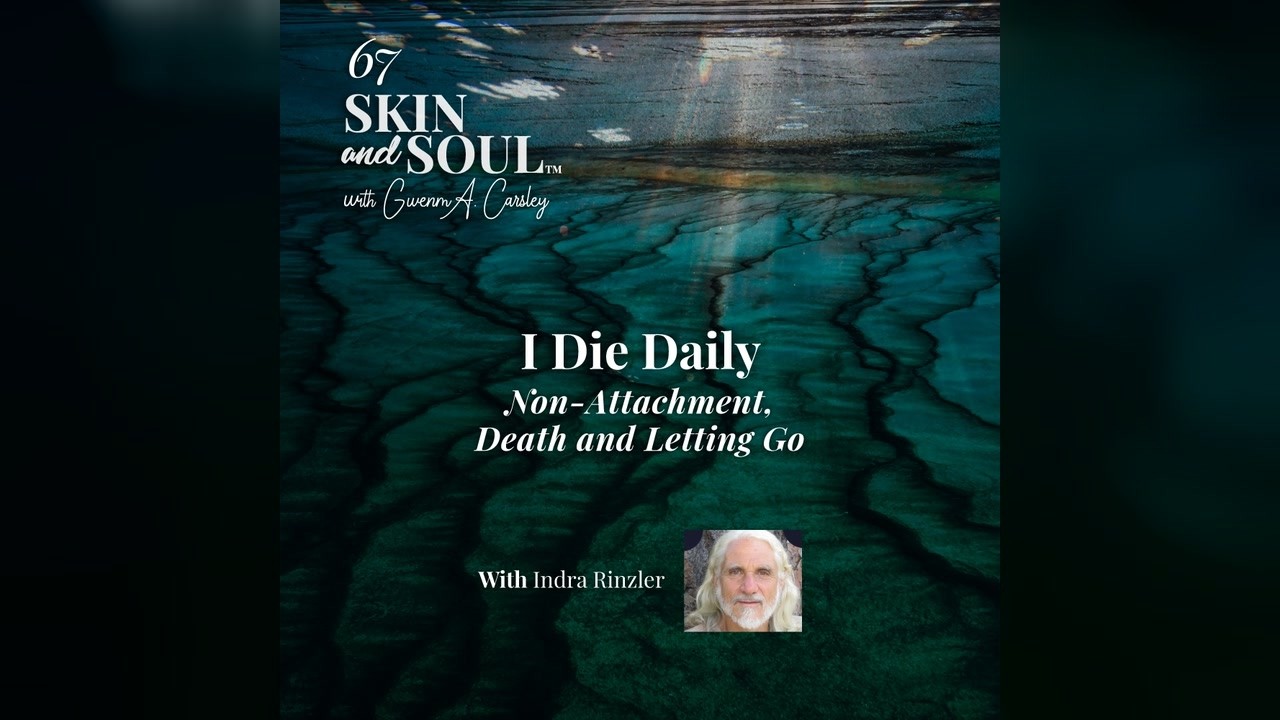
0:00 Welcome to Skin and Soul. I'm Gwenm Carsley, a transformational body, sex and soul coach, and I'm inviting you on a bold, unfiltered journey into the heart of our humanity through the lens of Eros. This is where we strip away the shame, dive into the unspoken and embrace the wild, raw truth of our desires. Together we'll crack open the taboo, uncover our deepest intimacies and awaken the pulse of our sexual essence. Because real transformation, it's messy, it's thrilling, and it's oh so delicious. Buckle up loves. Skin and Soul Beyond the Pale starts in three, two, one. Let's go.
0:40 Hello and welcome. I'm Gwenm. I'm your host of Skin and Soul Beyond the Pale. The question on the table today is, so what does it actually mean to love without holding on? And what does it mean to live fully in the body, in this flesh, while also learning to let go? I'm in conversation today with Indra Rinzler, and when we first spoke, he said this to me, that the better life is the life that is free of all the desires. And of course, in my resistance, I told him that I felt that desire was an essential fuel to living.
1:13 Indra has been a spiritual seeker since 1971. He has spent 20 years inside a spiritual community and another 20 returning back and forth to India. He's a Vedic astrologer, Enneagram teacher, and the author of the award-winning book Indra's Net. And in it, he writes that we live superficially rather than allowing ourselves to be touched and held, that we spend decades perfecting the game. So welcome. Wow. I said those things? You did. You did. It was a great conversation. Well, I hope this one is equally as great, and thank you for having me.
1:54 Oh, it's a pleasure. You know what? And I told you I like to read all of my guest books. So this one comes in, and you said, you don't need to read it all. It comes in pieces, like open it up. And I just found myself drawn inside. And I'm always drawn to the places and spaces of detachment, death, impermanence. Yes, of course. Yeah. I wouldn't expect it any other way from you. Right? But it's been my struggle because, you know, as someone who is, I'm wholly attached to this body. I know it really well.
2:32 You know, I've come to recognize how much, how we get so attached to our identities. And part of what I wanted to chat with you today is because we were talking about detachment and letting go of the suffering and the desires. And I was like, I don't know. Isn't that part of being in the body? Isn't that part of being in this flesh? Well, you can still in, well, just a second. So when I said I would expect it from you, what I was referring to is that I always had the ability to, like if I had co-workers, you know, if I was the boss, I would get them right on the one thing they did wrong rather than all the things they did right.
3:13 So putting the thumb right on the spot. So I would expect you to open the book up as to what was the strongest and most important to you. Feeling desirable and wanting to be desired and having desires are part of being in the body and are wonderful. But the attachment to those creates suffering. And that's not, that's not, that's not, to me, that is not desirable. That I can still enjoy, I can enjoy the tomatoes from my garden. I can enjoy the, the, the grapes from the grapevines.
3:55 But if I have an attachment to them, then the birds eat them all. And then I don't have them. And so I'm making the distinction between the, the attachment, the non-attachment, not detachment, but the non-attachment to these, to pleasures or to aspects of our life. And the, and the, and the suffering that comes when we are, you know, so attached to it that we can't live without them. Yeah. And I just want to draw like the, the, the difference between non-attachment to disconnection versus grieving and, and suffering.
4:39 Cause I think those are very different things. And I'm, I mean, I'm, I, cause I'm slow on the clock, you know, that I, I'm still learning how to ingest non-attachment. Because I think many people also relate that to non-commitment or non, or just disconnection. Well, that is, that is, that can be a problem. And that's a stage. I wouldn't say it's a problem, but I would say it's a stage that, that we think of the, we think of enlightenment as a void. We think of being aware as being a void. We think of emptiness. Great example, Buddhist term, emptiness as being a void.
5:17 But it's actually, because everything is contained there, but there's no attachment to the, to the aspects of it. And so there's a freedom. Being able to do, being attached to do something is not freedom. Being able to do it is not freedom if you have to do it. The, the freedom comes in when you have the ability to pick and choose. And that's where the, the enjoyment is higher. And the, the, the, there's no suffering in the non-attachment because we can give and take. But it doesn't mean we enjoy it any less when we have it or do it.
6:03 Right. And it doesn't mean that we don't feel the things moving through us. Yes. We feel, we feel the, yeah, we hold on to, if I understand you correctly, we hold on to the desires. And so they don't move through us when they move through us, then we have non-attachment in the, and it's just as pleasurable, even more pleasurable because we can take it and leave it. If we, if we're committed to having it a certain way, that is not pleasurable. It may be pleasurable short-term. It may be pleasurable when we're, when we're young and inexperienced, but as you get older, the difference between 20s and 30s and 40s is, is that we, we have more experience with these things.
6:46 And all of a sudden they're not as the, the attachment to it. We, we recognize the attachment to it is the problem. It's not the experience itself. Yeah. And I think there's a lot of awareness that has to come. I mean, over the twenties, thirties and forties, and that what happens is either people come into that awareness or there's like a complete shutdown, sort of a, a denial, if you will. So rather than being non-attached, there's, the gripping of attachment has created its own barriers. Right. And the, and the experience is that, somebody wrote me recently about how, how, I can't remember the exact quote, but the cruelty of God, because, because the, the, the situations have gotten more and more intense.
7:39 I just think that's, you know, that's God's love that is because you're not getting it. And, and so the, the, the breakups become worse and the, and the, and the recoveries become worse and the re the resentments become worse because, because we're, we're not learning the lessons. We're not seeing the lessons that we need to get. And as soon as we laugh at our situations, rather than, I'm going to say cry, you know, it doesn't have to be crying, but just use that as an analogy there.
8:09 then, then all of a sudden the sun shines again, you know, if we get upset that it's cloudy all the time, the quickest way to get it sunny is to appreciate the clouds. Hmm. I like that. Yeah. I like that a lot because that's, you know, I was just talking to a friend of mine, both of us are kind of nomadic now she's more nomadic than I am. And so it doesn't get attached. And we, we talk a lot about, Oh, what does it mean to have roots versus what does it mean to like, to, to, to move, to feel the restlessness, whether that's running, whether that's like paying attention to your, to your, to your knowing, when it's, and just removing from the attachment of the permanence of the place, for instance, which could be a relationship.
8:55 It could be anything, but, I think that's the attachment to that. That's the story of non-attachment. Okay. The personality style of running away. It's my personal personality style, but I'm sorry, go ahead. No, I, I know. I like that. I mean, I think there's, do I think sometimes I feel like it's running away and sometimes I feel as though. Because the neutral, the neutral doesn't care. The neutral is open to everything. But if there's a position that it's time to leave, then, I mean, well, there is a knowing when there's time to leave, but most of it is, is that, you know, it's the head. It's not the, it's not the gut.
9:36 Right. So then what is the knowing piece? How would you describe the knowing that it's not like from coming from the ego or the, I know, but what you say, the, I know. So, so, so, so I had this experience, 20, 20 years ago. I, I, when I was, traveling, I was an importer. I don't know if I told you this story, but I was an importer for, for 12 years. And I would travel the world, buying handicrafts to come, to bring back to the U S and sell. And I had to plan these trips pretty well so that I would have plane tickets.
10:15 And I would, I, I normally would be in a new country, a new city for about four days. And, and if I, and if I found there was more to do there, then the next time I would stay longer. But I, I couldn't because I wanted to have the ticket set and I, I, I needed to plan it in order to, not get stuck because I had deadlines and things had to be sent and shipping and such. So I got to the position where occasionally I would have an extra half a day or a day.
10:50 And the thought would come, well, what do I want to do? Do I want to go to a museum? Do I want to take a walk? Do I want to sit by the river? Do I want to go to sleep? Do I want to get a tea or go have something to eat? And, and, I realized that the mind couldn't figure it out. There were too many choices and there was too much going on. And so what I learned, so what I started to experience was that I would just sit there until I felt the answer. And if it took 20 minutes or a half hour, I didn't really care. and the, the feeling was, it's not a mental.
11:21 I don't make any decisions in my head and make them all in my gut on how do I feel. And I, I don't have to analyze it. It's just a, it's just a feeling. And, and there's no second guessing the feeling, whatever I decided was right in the time. It doesn't mean the next day I would make the right decision. It doesn't even mean three hours later that I would make the same decision. but the fact was, is that I learned to, to wait until I felt the right answer and then I would act accordingly. And then I started living my whole life that way.
11:53 And so that I call the knowing that it's a, that it's a gut feel that, that is, that has no pro and cons. It doesn't have any mental, it doesn't need to be analyzed. It's just a feeling that we learn to experience that we call it, we can call it intuition. it's like intuition, but it's a, it's perhaps a deeper knowing. it's a deeper feeling that, that's just a knowing that, and, and where do we experience it? Well, you know, your outfit, even if you changed it four times for tonight, at some point you look in the mirror and you just know, and, and, why do you go to the class you go to?
12:39 Because you just know, and why do you pick the, you know, out of, dating 10 people that one you pick as, as the one, how do you, how do you figure that out? If you do it mentally, it doesn't work very well, but if you do it from a knowing, then it doesn't mean you stay together. I had a, I had a client recently tell me that they were, that they were married 12 years and that it was a failure. And I said, I said, I said, you know, it wasn't a failure.
13:09 It just ended, you know, that's not a failure. You've, you, you experienced together what you had to experience together. So, then the knowing is, is this, voice, this, being inside of us, this feeling inside of us that, that has clear, a conscious awareness. And that we don't have to second guess and is never wrong. It may not be correct, but it is never wrong because in the moment it is the right, it is the proper feeling. And, that doesn't mean at another time or another date, we might not come up with a different, solution or, or ending point.
13:56 Do you think that, there's a difference, not a difference, but there's a place of knowing and there's also a place of wounding. And so just kind of tapping into the difference, of the deep knowing versus coming from, let's say a place of, nervous system dysregulation or just like, you know, from an old trauma subconscious stuff. Well, well, that's not here and now. So, so that is, that, that is something we have to release that, that, that, that has an opinion. It's a holding, it, it has, it has the hurt and emotional connected with it.
14:34 And that's the opposite of knowing. And, while, while there are justifications in that we feel bad, you haven't said it yet, but, but I'm going to say nobody can hurt us. You know, it's like, they hurt me. This experience hurt me. No, we hurt us because we're the ones buying into it that the outer circumstance, where they, were they, kind words? Maybe not, but, but our, we have a choice as to whether we're going to be hurt by that because it's just as easily, if a four-year-old says it to us, we're just going to laugh and just say, that's cute.
15:11 But if, if our lover says it to us, all of a sudden it has a different weight and, and maybe there should be a different weight over a four-year-old. But, but, we're acting like the four-year-old when we hold it against them because, because they're doing the best that they can and, and they're reacting to their own reactions. And, when it goes back and forth, we're both, acting from hurt, immature places. And, and those are places where there is pain. And that's the suggestion is to, is to learn to live beyond that.
15:52 Yeah. To be able to learn to live in a relationship where you completely don't have the expectation or the projection onto the other, which is, I guess, the ideal. And I'm wondering, cause I know that you're a married man, you've been there for a while and that, and what your experience is inside of that. Well, our, our, our experience with inside that is we realized that we needed to take responsibility for our own shit. Yeah. And, and that the, the, that the other person isn't the fault, you know, that the, the other person, may not have had the greatest maturity at that particular moment.
16:31 But the reality of it is that, that, that whatever it is, it's our own work. And that, and that within that is the, the, somebody, I saw somebody posted a friend of mine who's writing a book posted. What's the greatest expectation within a, a long-term mature relationship. And, and, and, and, you know, somebody, you know, said some beautiful words, but I tried to tell them the greatest is no expectation to just be in the moment and to have no expectation. And, and, and get the gift of other person's love expressed their own way rather than needing it to be expressed my way, because that is never going to be satisfied.
17:19 I mean, it may, it may have moments of satisfaction, but it's not, it, it'll never end up being completely satisfied because it'll always be, it needs to be said more. It needs to be said sweeter. It needs to be said before coffee. It needs to be said after coffee. I mean, there's, there's, there's a, the, the mind will, will continually create a bunch of rules and expectations. Yeah. It'll keep putting like the goalpost in front. Yeah. The goalposts keep moving. Yeah, exactly. It keeps like, it's like always like, I always think of the carrot that's right in front of, was it Bugs Bunny or whatever?
17:57 Yeah. So they move it faster. So the rabbit will run faster. Yeah. Yeah. But the excitement is actually in the trying to get, I think it's always in trying to get the carrot, but recognizing that you're trying, that it's the journey of getting the carrot that you'll never, that you're never going to get. That where, where the jewels lie. Yeah. And when you get it, then it isn't satisfying. When you, oh yeah, no, absolutely not. Cause then you need a whole new vegetable. Yeah. Yeah. When you get it, that's the, you know, that then, you know, you open the Christmas present that you've been waiting for and it isn't what you wanted.
18:31 And then there's the disappointment and it's. Or it's exactly what you wanted. And it's not the reaction. It's not the feeling that you were hoping for. Because now you have it, you know. Because now you have it. Yeah. So what's next? I, I, I sometimes use the example that you have the perfect mate. You know, they're the most beautiful or handsome. They're on time. They're rich. They take care of you. You know, a hair is never out of place. They're, they're always beholden to, to whatever, you know, cook the meal or provide.
19:00 And you don't even have to ask them to take out the garbage, whatever it is. And then you get upset because they're never late, because they're never disappointed, because they're never angry. And, and, and you, you come up with why, why do you have to be so perfect? That we can't, that even with the perfect mate, we're going to find a fault with that. And so, and so what the solution is, just to make clear, the solution is to let go of the expectations. And just to accept what you have.
19:30 That if it's a cloudy day, then that's beautiful. If it's a sunny day, then that's beautiful. If it rains today, isn't it wonderful? The plants will, will drink. And, and then in that moment, then there's nothing that is missing because everything is complete as it is. I think, you know, what comes to mind for me, because I love all of this work and where I find it really challenging is where it's really difficult. Like I've got, I've had a friend who's lost her daughter. I had, you know, there's been losses.
20:01 There's, there's major tragedies and how people can live inside the work with richness, even in places of deep pain. Well, yeah. Beautiful. Touches my heart. So the thing is, is that we're not in control of any, every, anything, everything. We're not in control of everything. We're not even in control of anything. That, that the divinity is in control. And, and the daughter has her own karma and, and spirit. And it was her time. And, and so that, that it's, it's, it's, it's not, everything is through me, not from me.
20:41 It's not my stories. It's not my piece. It's not my wisdom. It's, it's something that I'm plugging into that's been here for millennia. And that I make myself, if I, if I feel hurt, then I'm trying to make, then I have a need to make myself special. I make myself special. I am unique, but I am not special in this sense of being the only one that's unique. Yeah. And I think, I mean, in some, I mean, let's face it, there's some lessons or karmic or, or just how life plays out that are more, more challenging than others.
21:16 And so. Absolutely. I've, I've watched people go through extraordinary things, horrific things, and, and be able to still see the beauty of life and the existence of everything. And then there are others that absolutely crumble under the weight of it. and so like looking at non-attachment, connection versus disconnection, I always choose connection. You know, I, I always find that the beauty of life is, is being in it. I think for some people, I could, I could see the challenge, you know, more than others, certainly around, let's say like my mom, who's really had a tough time in life.
21:58 Being able to stay within the body, stay connected within the body. so I'm wondering around, the work that you do in terms of astrology, Vedic astrology. It used to be that astrology was really, I think, used as a divination tool, right? Like you, you tell me, that's where it started, right? Like, it's like, tell me, tell me the future. Tell me it's going to be okay. Or that they, in the, about three or 4,000 beasts, three or 4,000 years ago, they, they killed millions of probably young women and, and animals in order to figure out which way an organ was pointing in order to have to, to, to know what to do.
22:45 They used human sacrifice as divination. And then astrology became forms of astrology or, or other kinds of divinations became simpler and more economical ways to, to achieve the same goal. Yes. That's where it started. Mm-hmm. So how do you guide or, or teach others about their own self-awareness through your astrology? Especially since I think so many people are like desperate around who's my soulmate? When am I going to do this? When am I going to, like, when am I going to be successful? And yada, yada.
23:24 Well, I, yeah, these questions really, they, they drive me up a wall a little bit. I had a, I had a lady, worked with a lady yesterday who has, knows enough about astrology to be dangerous. And, and she was totally stuck because all of her signs in astrology, all the signs she used, told her negativity. And, and I told her that's why I don't use any of those signs, those particular aspects or things that she was looking at. I consider the, the, it's very simple the way I do it.
23:56 I consider that there are high sides to planetary energy and low sides. That, that we can be, with, with sun self-aware on the high side of sun, low self-esteem on the low side of sun. So those are the two choices. We don't spend much time in the middle. The middle is not worried about being self-aware or not worrying about being, low self-esteem. We, we, we, we can go there, but we don't spend much time there. It's either one or the other. So the, the opportunity is just to, is to be aware, to look at which one am I in?
24:31 Because if you're on the low side, then you're going to find fault with yourself. You're going to feel insecure. You're going to demean yourself or other people. you're going to feel challenged on the high side. You're self-aware and, and, whether you could get arrogant and nothing can touch me, you know. I mean, that's, that's the low side of the high side. But the, the opportunity here is to become aware of the, strengths and weaknesses of our chart in order to become aware of where are, are, challenges.
25:05 Because some of them, some of the, planets are in a very neutral position and are not generally affected. They're neither good nor bad, but they're very neutral and not where our challenges are. But where we have in our chart, we have planets that are, that are, triggered by nature. Then that, those are our themes in our lives of where the challenges come up. And the, the opportunity is to observe whether we're on the high side or the low side, and then make a change to the, to the high side.
25:37 If, in fact, we want to let go of the pain and suffering that we're feeling. Yeah. So it becomes an awareness tool of what is going and putting things in context and, and being able to see where you are inside of your life so that you can maneuver in a, in a place of awareness. That's the way I have come to do it, 50 plus years. It took me 35 years to become mature enough and aware enough to be able to pick up astrology this way.
26:09 And, it's a help. It can be a help for people when they can, when they can hear, hear it and, and listen to it. And where, where are your blind spots these days? Where are my blind spots these days? Oh, that's a revealing question. I just passed 80. I don't have much time left. I guess that's a blind spot, but I'm content with that. Happy birthday. Yeah. Right. Two months ago, two months ago already. I'm, I'm getting used to it now. I can't say, I don't know what my blind spots are.
26:48 You know, that I, my, my wife says that I get, that I can be self, self centered, you know, self involved. So that seems to be a blind spot. And until, until she's around and reminds me, perhaps I get to, to, I don't take enough initiative. Maybe I need to, sell my book more, but I don't feel to, but, Where for you do you think today, like, is your, you know, going back a little bit around death and impermanence and, and non-attachment. Are there any things that you find that when I say blind spots, like where, you feel that you are still attached?
27:33 Well, I mean, we're always a little bit attached, you know, until we, until we have the, there, there was a, I saw a, a video online of a person having their mahasamadhi. That, there was a, dying that, that, there was a bunch of, Buddhist priests chanting. It was a, it was a Indian or Hindu, or, I mean, or Nepalese or somebody of Buddhist. It was all a religious ceremony, but the, the man, everybody was chanting and there must've been a hundred people there to, to see him off.
28:11 And he came in and he lied down and, you know, a minute or two later he was gone. Wow. And, pretty powerful, you know, until you can do that, you know, there's his attachment and, and, and, and that's okay. You know, the, the, the, the bliss is there, the joy is there, you know, you know, probably still attached to food, you know, probably still attached to probably don't meditate deep enough. I don't meditate often enough. Don't think of God often enough, but that doesn't mean that I'm not thinking of God and considering everything to be divinity.
28:51 But, but it's more of a, rather than chastise myself, it's more of a being with it that, that these are things that I could do better, but I don't want to get into, a downslope of, throwing out the baby, the baby with the bathwater. You know, not, it's not about me that, that, that there is an incredible detachment about all of it, even though it may sound, self-centered at times. Hmm. Well, part of it's self-centered. Why, why would it be self-centered in what way? Well, because, because, you know, I might think of, I might give an example of my own, situation rather than have commiseration with her feelings.
29:38 I might give a situation. This is my positive, positive outlook story, you know, always going to positive outlook story, not wanting to feel the pain. This is your friend, the traveler, you know, the, the, always the nomad, you know, I'm feeling, I'm feeling the wind in my sail. You know, we're there, we're, I'm not saying your friend is like this, but this is my feeling. This is because I know this story is, is that it's, it's, it looks like we make it look like running toward, but it's actually running from, and we don't like boredom.
30:11 And so we don't. And that's something, I mean, I can speak to you honestly, right? Because I, I've always had a calling to move. I, I already knew when I was young that I didn't want to live where I was living. Like I just, I was called to move, but, and then, and then when I got to my next destination, I also knew that I wasn't, that I wasn't meant to be there. And that lasted actually 20 years until I was able to let that go.
30:35 and with an honest feeling of needing to move on and, and found myself in places that I, I felt like, oh, I really, I really could have roots here. I really, my attachment is, oh, I really enjoy this place versus I don't enjoy this place. And as I've, I've moved around, now quite a bit, I, I do pay attention to what my body kind of resonates with. I'm going to say, you know, there's places that I definitely feel like, oh, I feel more home or I feel more energetically aligned with a place.
31:08 and there's also been the elements of, oh, I'm restless. Yes, is this, is this, you know, me being, not being able to sit with myself and being able to sit in the discomfort or, you know, is this, is this, something, a greater calling, if you will, or like just something that says, oh yeah, you must move on. But. Well, I think, I think there's an important indicator here is, are you present where you're at? Because if you're, because if one is always thinking about greener pastures and not really present where they're at, then that's, that's, that's a very sticky story.
31:43 But, to feel, to be somewhere else, there's, there's nothing wrong with that. To change the change of the, the seasons change, you know, time changes, with the, the governments change the time. So time isn't even consistent either. But the reality of it is, is that, that, yeah, sometimes we want to see a different, sites. But, the important thing is to be a hundred percent where you are when you're there and not always to be, because we have, the, the, we have the situation where we're always thinking about the, the place we came from or the place we're going to and never really land, with the relationship we have or where the place that we're at or the job that we're at.
32:34 It's always, it's always looking outside the current. And so if you're completely where you're at, at the time, then that's, that's a completely different story. And yes, there is, there comes a time when we, we have to move. Yeah. I like your analogy on the plane that, that to me is, you know, when I'm sitting on a plane and I'm having, I want to say a good day, cause I'm, I always, I'm terrified of flying, but, I've had my moments of just surrendering on the plane and being so good with whatever is.
33:06 and in those moments, there's, there's nothing else there because there's nowhere else you can go. You are just with yourself. You're just over the clouds. You're not in control. and it's, it's quite an amazing experience to be in that presence of that stillness. I'm going to call it. Yeah. You're talking about I die daily from the book. Yeah. Yeah. So, I mean, the fact is, is we're not in control when we're not on the plane, but when we're on the plane, it's really clear to see we're not in control.
33:39 Yeah. Yeah. Yeah. Once that door closes, it's like, okay, whatever happens, happens. Doesn't really matter what. Yeah. The learning to be with it and just, I, you know, I, I learned to enjoy the, the emptiness because, because, there's usually a big, hurry up on the way out. And then when you get there, then there's the jet lag and the, and, the things there. And there's this in between time, which is, which you, you know, you can't, there's very little that you can do. And I've come to enjoy that, that time because, yeah, because it's just, it's
34:22 just, it's just quiet and it's constant. You know, you hear the, the, the, the, the, the, the, the play, the plane noise and, and, you stare at a screen or the, whether it's on or not. And, and, you know, sometimes you sleep and sometimes you don't sleep and occasionally they bring you food. It's just, I love the experience. Now I used to medicate myself wholeheartedly. Definitely. you know, the Percocet type, was, was when I, and then I, and then I realized I really, my body wants to feel whatever it is, right.
34:57 Whether it's the fear or whatever, I just keep telling myself, this is my body just having a resistance moment of deciding it wants to survive something imaginary. That's not here, but it's just fighting for its noise to survive. which I, which I became acutely aware of. So this, this reminds me of another interesting point is that, is that what I've experienced recently is that I can feel a discomfort. Like, like, let's use this example on a plane. I can feel a discomfort in Indra that, that, that we're, we're 35,000 feet in the
35:34 air and we're over ocean. And if something happens, we don't have a chance, but I can all, I can, I can view it rather than be in it. I can view it as happening in Indra and I can feel a detachment from it, a non-attachment to it. And also be in that I am spirit and I'm, and that divinity is in control and whatever happens, you know, that I have to accept that whatever happens is what happens. And so I can feel both at the same time, both the discomfort of a restlessness, you know,
36:13 that, you know, in our, in our life, will somebody call, you know, what are they thinking? What's going on? You know, at the same time, with, with the detachment to it, and live more in that. I can see the other going on in Indra's, in Indra's body, but I don't have to attach myself to it. Even though it's going on, I can, I can, I can coexist with it in a plane of, in a, in a, in a, from a plane, not an airplane, but a plane of viewing it in a non-attached
36:51 way that it's going on, but not, in it, but not of it. Okay. So let me add another layer of complexity, which is a manifestation. And I don't know if you believe in manifestation or not, but like coming from the place of non-attachment and just allowing life to move through, you know, whether the, the person calls or not, for instance, the lover calls, or you want this person to call. We often have this kind of knowing that says, oh, I've had this thought. And then the phone rings.
37:21 yeah, absolutely. And where we feel another, or we have this sense of, whether it's soulmates, like you said, like you meet somebody and you know, this is, this is going to be a person that's, you know, deeply connected to my heart. And then from there on you, you allow the, the scene, the, the, the play to happen as it happens, as opposed to trying to direct it in the exact way that you want it to go. Well, we learned that the directing doesn't really work that, you know, mostly the
37:55 twenties, you know, we try to direct, but it doesn't seem to really work. And, so eventually we let go of it and we let, we, we, we, we, we, I'm more concerned with divinity doing what divinity wants and what Indra wants. I may have a, I may have a scenario. I might be able to write a Disney story and have a, and have a desire, you know, I want my team to win, but if it doesn't win, then I've got to, accept that story as, as,
38:23 as perfect too, that, you know, that, we, we learn from our defeat. We, we're going to play better next time. we played a good game, you know, there was a sportsmanship on the field, whatever it is. it's never ending, you know, it's never ending. It doesn't end at the end of the life. it, it, it seemingly that it doesn't end with one relationship. It doesn't end with the perfect relationship, because there's still, you lose the relationship, you, you have moments of, of, not, of, you know, a little
39:06 bitey comment because the person didn't sleep well enough or something. And, and, and you're always tested not to take it personal and, and to take a higher road. And, in, in, until you're, when you're completely free, then the, the, then the tests sort of pass by, you know? Yeah. I feel like there's always a constant test, even if the test is just, can you enjoy this without trying to make it more than it is? Can you just sit with it, whatever it is the best part without already either doom scrolling
39:43 or doom, you know, or having the perfect ending or making it, you know, 10 steps ahead. Can you just be in what it is? Absolutely. And then you can also enjoy the, the, the little, scenes that come up, you know, that I, I was in my, my wife's motor home the other day doing a session that, she was painting this, the cottage that I'm in now. And, sometimes I do sessions in the house if she's not there, but I have different places. So I was in the motor home and then something happened with the, the door, plastic door
40:22 part. And, and, I had to, you know, had to, because she is looking for radical honesty, I had to go over there and say, I did a boo-boo. But, I found the part and, and, and, you know, we went through some stories with it. I ended up finding a person that she can call who, who knows every part in her motor home. If she needs a part, she now knows exactly who to call, who will give her the part number. And when we, we put it in the old, there were two parts, the one small part I broke and we
40:59 replaced that. But the other part of this door thing, the old one didn't seem to work anymore, but I was able to get the new one in. And when I, we put the new one in and she has to use it a little bit differently than she did before, but it works well. At the end of all of this, which is my point, she gave me a hug that I may never forget. There was appreciation. There was completely forgetting that I broke it. And I, she said, I, she, I said, is it okay?
41:30 At the beginning, I said, is it okay? She said, I have a clumsy husband. I said, okay. You know, now the truth is out. Okay. Indra can be clumsy. No question about it. But when, when we worked together and I paid for this little part and, and we got it in and we, and we, and it's better than it was before. And she gave me this hug. This hug is, is everything she puts into that hug. It's, it's not words. It's that hug. And that hug is memorable and it doesn't need, it doesn't need the, the comment is extraneous.
42:08 It's, it's actually, silence is much stronger than words. It's the look that has all the energy. And when you put it into words that, that, makes it, weaker. You know what I mean? So, so it was a wonderful experience. And now the door is, is better and has, it's all good karma everywhere. And it's, things are forgotten, you know? And this is a lifetime of working together. 20 years. 20 years. Yeah. It's a lifetime. Yeah. Well, yeah. I mean, we, we met in our fifties and, our, teacher at the time said,
42:55 a marriage made in heaven. Hmm. Beautiful. So, yeah, that's, I feel very blessed, but that doesn't mean that, you know, we're always together and it doesn't mean that it's, the, the, the, the, the, we're never separate. I wanted to talk about this before separation. We're never separate, but that doesn't mean we're always together. Yeah. There's presence or there's even if, and, and you can correct me if I'm wrong, but what I'm hearing is that there's, that there's always an energetic presence, that there's presence, that there's connection, but it doesn't mean that you're side by side, and talking
43:36 each other to death. Cause I think that happens a lot today too, is there's, we advocate for communication and I also advocate for communication, but there is also like killing the dead horse. We are not talking to death. That is for sure. That's okay. But that also keeps the excitement. I think oftentimes there's, there's something in the unspoken, like you said, there's something in the, in that just. Well, there's personality styles in this, this is the Enneagram. And there's personality styles and, and, and not everybody is the same.
44:08 And we have to learn to, loving means that we appreciate the way that they are, not the way that we, the way that we, that we have a want them to be a certain way. And so the, the separation, the feelings of separation are never there. And, and, but that doesn't mean that we're together. And, and, I had a, I had a friend this winter tell me that, that he was, eight off and four on. And I said, we're, we're eight on and four off. I like that better.
44:39 Yeah. Those are months, you know. Okay. I was like days. Yeah. Those are months. Not hours. Somebody's a nurse or something. Yeah. Beautiful. Thank you. Okay. I'm just going to shift us to, the questions I ask, all of my lovely guests. Okay. Here we go. I'm going to ask you, yeah. And then I will ask you what your favorite, astrology method is. Cause I know you do various, versions there up what your favorite readings are. All right. So the first question on the table is what is one truth?
45:10 Your body has always known that your mind took years to catch up to, one more time, please. What is one truth that your body has always known that your mind took years to catch up to the mind? Meaning physical, boy, I don't let me, let me think about this. Let me, let me feel with that. I don't think when I say think, I mean feel, see, I don't know exactly what you're referring to, but, I know that, it took me a while to learn how I get angry and, how
45:39 I, I get, harder to be with when I get stressed and the anger comes out and, it took me a while to learn that. Beautiful. Okay. Yeah. Perfect. Perfect. Okay. Great. So second question, what is the most intimate moment you've ever had that had nothing to do with sex? Well, at, at the, the van, you know, getting this hug afterwards, this hug of a total appreciation. we have lots of moments of appreciation that are not sexual, but this, this hug, it's a look. I'll tell you another one is the way she makes my lentil soup.
46:21 not a big, not a big, cook, but she will, you know, you know, she'll notice that, because she does the shopping, and, and, she's very aware of these things. and so, you know, my soup is low and then the lentils come out and she, the onion will appear and she makes a lentil soup and she puts so love. You've heard about, putting love into cooking this, there's so much love into the cooking and it's wordless. It's not looking for it. She wants to be appreciated, but the appreciation is in the, is in the, it's not in words
46:59 because I don't know that she trusts that. but, but it's, it's in the, it's in the thank you of the eating the soup every time and enjoying it. It's, I like to say that, that, I've learned to enjoy the same meals every day, which is a little unusual for me, but the last years I've learned to enjoy the same meals because it's like every day, it's like I eat it for the first time. Mm. Thank you. If you could be remembered for one sensation you gave someone, what would it be?
47:34 One sensation. Well, I would, you know, the freedom from readings in the readings, the, the, the opportunity for them to see themselves as they are. Already accomplished. A lady told me, a lady told me last winter, she said, I came back for two months this year to India because last winter you told me to come back for two months. I said, I don't remember saying that, but, but, that she heard that and, and listened and isn't that beautiful. Mm. Thank you. Now, if pleasure were a language, what would your first word be?
48:16 If pleasure were a language.
48:20 Pleasure. These aren't easy questions. If pleasure was a language, what would my first word be? Today. It's a great answer. I love it. If your erotic life and take that as Eros had a title, like a novel or a film, what would it be called?
48:44 The never ending story. Oh, and I love that movie. What is one thing that you've never said out loud, but you wish someone would ask you about? Ah, well, I like talking about the book, my book, the book that came through me, not from me. Thank you. I'll remember to ask you before we go. What is one part of your erotic self that you are still afraid to bring to the light? Boy, erotic self. Let's say deepest self. I think. Women are attractive. What dies in you when you pretend and what comes alive in you when you don't?
49:29 What dies in me when I pretend? Presence. And then what comes alive in you when you don't? Joy. Beautiful. Completeness. Completeness. Thank you. Now finish this sentence. When I leave this life, I want my skin to remember. What comes is sunshine. Beautiful. And if the soul has a scent, what does yours smell like today? Compost. Love it. Love it. Amazing. So to bring in that last piece of your book, is there anything that you want to say about your book? Well, it took eight years to manifest.
50:13 It was. They're my experiences, but it's all from divinity. And it will help people. And I don't need it to be to be recognized. But the works are, have a depth to them that will help people. And I long for the time when people are ready to let go of glitter and become excited about their true selves. Mm-hmm. Thank you. And I would, you know what? I'm going to second that because I think it's such a beautiful book. And you start off saying, I finally got to write the book that I wanted to write.
51:08 And I would agree that what I've read and so far, and I've gotten through the very first 2022 major life, what do you call them? Major truths. Major truths. That what I love about them is that they're so accessible. The reflections and the practices are these just beautiful ways in without, I want to say, they're just really beautifully accessible. Like, it's just like, oh, I can do this. I can lie on a bench and just let myself melt into the, and who hasn't, you know, just taken a moment.
51:48 It reminded me of those precious moments when we allow ourselves to dissolve a little bit into life and just stop the noise that's going on here and be exactly in the moment. And then just brought up a whole whack of questions. And of course, we focused a lot on death today. Death, the permanence, all of that. And like, I die daily. It's just, I think I'm on a kick of, you know, removing all identities and slowing them on. Well, if you've been sitting in the book, I mean, it's not surprising that you have a more
52:23 seriousness and that I die daily is the, you know, in meditation, we're practicing dying. Yeah. Which I, and I want it so, and just like a last note, because the I die daily, I had this experience with animals and I had, you know, my cat lived to be something extraordinarily, you know, like 19 years old. And by the time she passed, she was so, she actually passed before we had to give her anything. We just allowed her to go to sleep. And before anything was administered, she was already gone.
52:58 She was so ready to, to leave this life. And then we had Jack Russell's and we had a Jack Russell's just, just that spirit was so, that life force was like, I am not going anywhere. And I always think of myself as like, this body is not going anywhere, you know? And how much some people, and I'm hoping I get there. I hope I have like the next few decades to get to practice.
53:27 Walking into a place of like, oh yeah, I'm, I'm just ready. I'm, I'm good with whatever. But I, I know that right now my body's like, nope, we're so good at this flesh. Hmm. So, well, it's, it's probably not your time. So you don't have to worry about it. No, it's not, it's, you are practicing it, even though you don't know it. Yeah. So thank you. so, if anyone wants a reading and we didn't get a chance to really talk about all of the, the readings that you do, but I'm going to invite everyone to go to Indra
53:59 Rinzler.net.com. Dot com. Yeah. Yeah. Dot com in Indra Rinzler.com. and you'll see all of the readings, to go and get his book, which I just think is a beautiful, you can read it from front to back. And as you said, just open it up. And if there's anything else that you want to say before we go today, I just want to thank you for being here. thank you for having me. Great. Beautiful. And to everyone else, it's a wrap. Have a beautiful week and I will see you next week.
54:35 Thank you for listening to skin and soul with me. Gwenm. Join me Fridays at 10 AM PST on Transformation Talk Radio. Catch the podcast. Anytime on your favorite platforms. You can follow me on Instagram at Loovology ready to take the next step. Book a compatibility call with me at gwenmcarsley.com.