
0:00 Welcome to Skin and Soul. I'm Gwenm Carsley, a transformational body, sex and soul coach, and I'm inviting you on a bold, unfiltered journey into the heart of our humanity through the lens of Eros. This is where we strip away the shame, dive into the unspoken, and embrace the wild, raw truth of our desires. Together we'll crack open the taboo, uncover our deepest intimacies, and awaken the pulse of our sexual essence. Because real transformation, it's messy, it's thrilling, and it's oh so true. Delicious. Buckle up loves. Skin and Soul Beyond the Pale starts in three, two, one. Let's go.
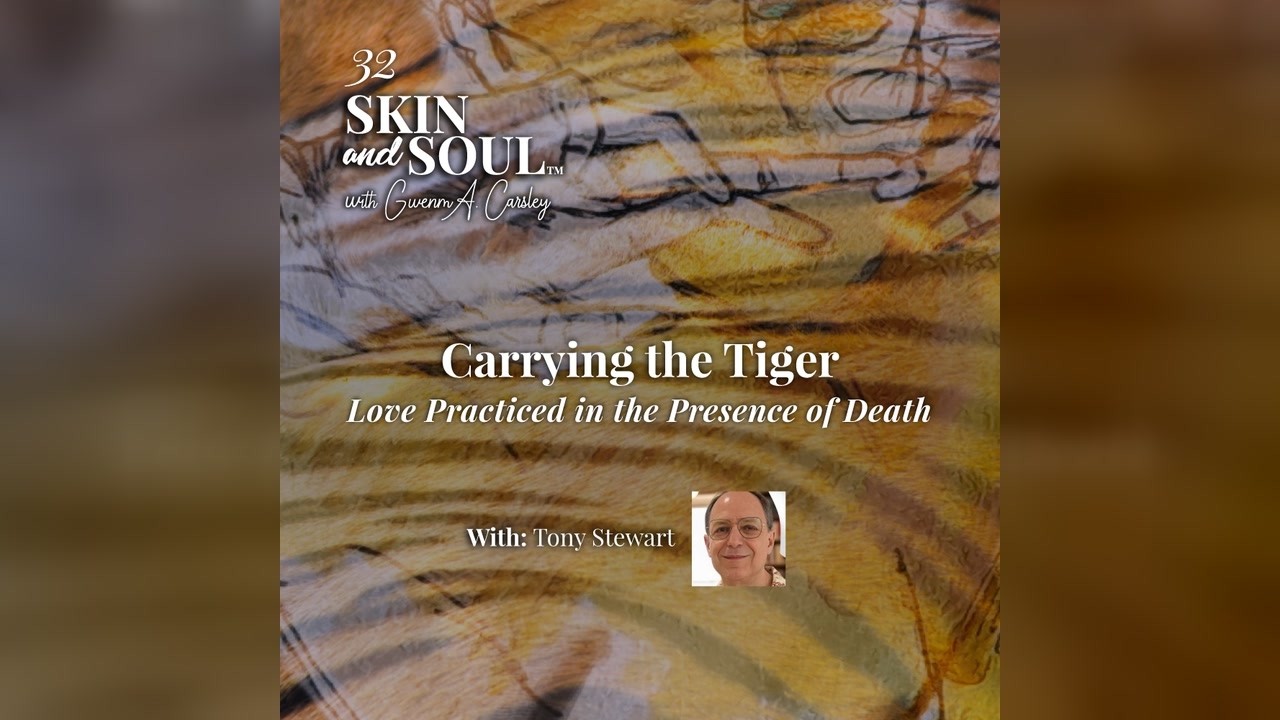
0:38 Welcome back. I'm Gwenm. I'm your host of Skin and Soul Beyond the Pale, and I have with me today Tony Stewart, who has written an incredible memoir. It's called Carrying the Tiger, Living with Cancer, Dying with Grace, Finding Joy While Grieving. This is a very palpable topic, though it's told with a lot of humor, love, grace. It's a documented journey of his now former deceased wife, the journey of seven years. But really, it's a love story. So I'm just going to start there. For me, it hit me as the most devotional love story that, you know, really surpasses anything from Romeo and Juliet. It is how it struck me. There was so much beautiful devotion in that.
1:22 And it's one told that was under pressure of terminal illness, time, uncertainty. And so, and the journey continues, which is beautiful. But I want to start there today in the love story. Because as we were talking, and I said to you, what I love about your journey is that it, it wasn't, you know, the day that you found out what it was that the stage four, right, that she had stage four cancer, but you bring us in beautifully by talking about the life that you guys had together, right, that there was so much life.
1:58 You traveled. And I'll let you tell a little bit of that story of like, you know, you traveled, you already had that aliveness. So I guess my first curiosity is around what, what was it like then what it when you got the news. So just tell us a little bit more about the life you had first. Oh, sure. Yeah. So Lynn Cotula was her name, my lovely wife. Lynn and I had been together 35, 30 years at the time of the diagnosis. It was closer to 35 by the time she died.
2:31 She was a painter and artist. She painted still life paintings, you know, fruits and things on a tabletop that were completely out of fashion for most of her career. It didn't matter. This is, this is what she did, what she needed to do. And I love that about her that, you know, every day she went to the studio and she just worked on paintings. And I read a much more, I wouldn't call it a normal career, but I did all kinds of things. I made films for a while. I was a business consultant, whatever.
3:07 But during the, each of the year, separated for some things, those of the time because of my work. So we decided quite early on that. Okay. There are two things. There are two things we decided. One is quantity time is as important as quality time. So it was interesting because I used to try to say, well, I'm, I'm back. Let's do this wonderful thing and this other thing. And she made it really clear. No, wait a minute. I need to just spend time with you. I need you to be with me as well as doing some wonderful thing or other.
3:44 But when we were in frequent fire moms for years and we said, we're going to do all these things. We started two years before the events of carrying the tiger. And we started taking these wonderful trips once a year, like three weeks to India, five weeks to India or Southeast Asia, where we would just let everything else slide around and be together and have adventures together. Yeah. And I remember you saying when, when, when you finally proposed to her, because you were worried about the age difference at first and you broke up with her, right. And said like, I'm, I'm, I can't deal with the age difference because of what you had witnessed with your dad. And, and then in the end you were like, no, I'm back. I made a mistake. And she said, well, I'll marry you, but only if you promise to kiss me every day. Right. Like you, like first, right.
4:34 If we were known about mindfulness, she would have been like an exemplar of mindfulness. The kissing was, it was like brushing out the door to go to rogue. If I gave her a peck, she would grab me. And so that's, that's not a real kiss. You stop and give me a real kiss before we go out the door. And she didn't mean a giant, sexy smooch necessarily. She met none when I was present, where my mind wasn't half read out the door. It was like, well, two of us connecting.
5:08 She, she was like that in so many ways. She ran into talking about my feelings with her. Of course. She indoctrinated you pretty quickly into presence, right? Like you're here with me now that if we're going to, you know, that it's, it's, it's connection. And you do, you do a lot of talking as you, you know, as you move through the illness, like there's no, there's no holding back. And I think it's part of what I, I mean, you're so candid in your, in your story.
5:38 There's like, there's nothing that's held back. So I just want to take a moment to, you know, what was your experience when you found out that she did indeed, like it was worse than you thought. Right. And, and I, yeah, so just. No, I wish she had cancer. She had some medical issues that no one thought were cancer, digestive issues, things like that. Those we'd been chasing for down for months. And then one day through, you know, just happens that those scanned her spine because of a lot of pain in her spine.
6:09 And that showed two animals in her lungs that she had no non-related issues. So suddenly the first thing we hear is you've got metastasized stage four cancer that's in the lungs and in your spine. Well, this is something you can take years to develop to reach that point. And by the time it does, unless you're bizarrely, not bizarrely, wonderfully lucky with some miracle drug that doesn't, there is no miracle drug for most people. It's a death sentence. And we discovered within a few days, most people who have that diagnosis die within six months to two years.
6:45 Yeah. And she had seven years. And so you went onto this journey. Yes. And I think I just wanted to get a moment of, and I asked this question because it's personal to me. I remember when my wife at the time got her diagnosis and I literally felt the ground leave from under my feet. Right. And I, and I was so conflicted, a slightly different circumstance to where you were, but I was holding both this, like, oh my God, this can't be true. Like I, you know, holding this grief and, and, and, and kind of having a sense of like what lies ahead and me feeling like, oh, I can't be here.
7:20 Like I just wanted to get outside of my body. So I just, you know, holding both of like so much love. And I just, I can't be sitting, like, I can't do this. So our situation was really different than that. And their personalities, presumably. The night we got the call, it wasn't a diagnosis. It was her GP calling to say, I'm looking with the, the, the scan report. And we've got these tumors. You'll be able to see an oncologist right away. So scary as shit, but we didn't know.
7:53 But I said to you now about, you know, life expectancy. We did not know that that meant we just thought this sounds really serious. And we went in two different directions. I, by nature, get very cool when first we're the crisis. That doesn't mean I'm not churning in some way inside, but it's just who I am. I, I, instead of running around like this or a road or whatever, it's like, okay, what do we do next? That's the next step. It's very much about getting from here to tomorrow to the day after.
8:28 And, I would say, she also didn't get wildly emotional, but it was much more emotional than me. And it's her body and her life that we were talking about. She, she let me do research. She'll talk to me, but she'll let me take the lewd on, we need to call this doctor. We need to call that doctor. I'm going to sit up till two in the morning when we're researching things, et cetera. She was like, I can't do that. She started to, but then it was like, I can't do that.
9:00 That scares me too much. That stuff. And meanwhile, what we both agreed to do tacitly, implicitly at the beginning, later, explicitly, when we talked about it weeks later, months later, was trying to give her, her normal life as much as possible. Which she wanted was to be able to the extent possible, to not get sucked into worrying, this take me, how long do I have, how horrible is that procedure? When we get to procedures later, she wanted to be able to have conversations with her friends that were like the old conversations.
9:43 and she didn't want to spend an hour talking about procedures and cancer with her best friends. And she wanted to go to the studio and keep painting. And a lot of what we did over the next few years, rather we realized it in mind as a direct guru, had the effect of giving her that. Well, that's great because I was wondering if like, you know, from what I had witnessed from what treatment can do is get sucked down the treatment and exactly what you're talking about, right?
10:14 Get down. It becomes like this. That's what the trajectory is, is the next treatment, the next treatment. And within that, how much life gets stripped away little bit by little bit. And you do describe that, right? You know, in each blog post of showing where there were openings, where life could surface again, if you will, right? I mean, she went through, I don't know, what, three, four or five spinal surgeries, you know, and rate severe radiation. Her spine was collapsed. I mean, there was like a lot happening.
10:47 And, you know, did you, you know, as you got, as you got deeper into treatment, did you feel, did you ever get to this place of like, is this worth it? Not for years. Eventually, eventually we stopped treatment. Eventually we decided it's not worth it. Pretty much all the different challenges we faced in those five years, and I should just explain, we were very, very lucky to find, get into a, Lynn got into a clinical trial for a miracle drug that was being investigated that had the possibility of, well, it had the tiny possibility of eliminating her cancer entirely,
11:31 but that almost never happened. That didn't happen to her. But it ended up holding down her tumor, so they stopped growing for years. So all of those multiple procedures were because of the damage that it had done to her spine right at the beginning, before we even knew about it. And then photo damage done by trying to get the tumors that were in her spine and them, that damaged her spine also. So she had multiple procedures, hospitalizations, and outpatient procedures for years involving her spine. But in those cases, even when it got horrible, even when she was in the hospital for weeks
12:10 and an infection and delusion with that, we just need to get through this because that drug is holding down her cancer. And we just get through this physical problem and get her out of the hospital. And she did almost die in the hospital at one point with an infection. But we were thinking she would die. Coming back, so what did you realize about living life in those moments? How did you really grasp onto the juices of life when you're in, when she's in pain, right? And I think there's a point where you talk about you don't even realize how exhausted you are,
12:54 how depleted you are. It takes you years, I think, before. Is it a year, a year and a half at least? I've had a year. A year. But I do have an answer to the question that you keep asking and I keep not answering. Good for evasion. Good for you. I mean, resuming in on all the bad stuff, I'm mentioning hospitalization and almost dying. The real love story part is how we helped each other to just notice the beauty that was around us, to spend time.
13:24 In the early, what was before the spine, before the worst of the spine, and then later after the treatments had fixed it up, we were like working through Central Park to get to the doctor's appointments. We were in New York City.
13:38 We got treatments in New York City. And there are things that normally you would take a taxi or the subway or something. And it really walked. And really, because it gave us a chance, it gave her a chance to be outside, to go way through. We went through Central Park where they have a beautiful nature that's there. And we noticed it. She noticed it. There's a wonderful moment. It's a tiny little moment in the book. And later on, she's like in urgent care reading for a hospital room.
14:12 And like so many people, it's happened to so many people, she's like stuck on a bed in a hallway for 36 hours because there were no beds upstairs in the hospital available yet. And we spent a lot of time talking, like raffing and talking about the little architectural details that they put in when they were in a little bris. Like, well, look how that's that join of the ceiling meeting the wall. We're not into architecture. It was just something that we could look at and appreciate.
14:44 In that case, not natural, but man-made. And I didn't even think about it until I was putting the book together and seeing all the notes we took and the journal entries. And I realized, oh, yeah. During that 36 hours when we spent most of the time trying to figure out, you know, when to flag down a nurse together to help her get to the bathroom because the nurses were so busy. But we were also like laughing about how silly the situation was and having fun conversations that aren't in the book at all with the people around us.
15:20 And then looking at these silly architectural details, and you realize, no, just looking for some juridic life, whatever.
15:31 Yeah. And there's so much, like, so you do when you write, you've got so much humor. And it's apparent about how each moment, how each precious moment is lived in the moment. And the reason I'm just going back to for a moment where it took you a year to ask for help, right? Because there's a lot of, I think, I mean, I know in my own experience that there is guilt. There is, I think, a survivor's guilt, right? Of like, and what can I do? And it's about the other person.
16:01 And we take for granted that the other person has all of the support around them. I mean, if you're lucky, obviously. But, you know, everybody's attention is on the illness, on the person with the illness. And it's very easy to get lost in that circus. And you say, like, you know, there's a point in time, and you talk about it really frankly, where you're like, you know, intimacy changes. You know, like, it's one thing to live with someone who's got six months to live. It's another when someone is living seven years and physical intimacies are not there, not in the same way.
16:36 So what did intimacy start to feel and look like for you? Wow. This flows out over the five or six years. In the beginning, I mean, we're talking about physical intimacy. We're talking about sex. Lynn's body. Emotional, yeah. Emotional, I mean, we were getting emotionally intimate all the way along. And that's huge.
17:05 Encouraged me in so many ways. So in that first year, when I hadn't gotten help for myself, like, later I got a therapist. I became, I was, we could no longer have intercourse. It just hurt her too much. I mean, it hurt her back too much. We didn't touch each other. We were having versions of sex, except that at times she was in too much pain. And actually, honestly, I'll say on this show, I don't usually say, she encouraged me to masturbate. It's like, I don't want my situation to deprive me of sexual pleasure.
17:43 Which is kind of wonderful if you think about it. It's so, what a gift, right? Like, to be that open in the relationship and to realize, like, I mean, I can see that you, you were, the two of you were so beautifully connected and just an honesty. Like, that you were able to be honest and open with yourself. Like, so much so, right? Except that during that first year, the stuff that I was not saying to her. And I don't think she would encourage me to masturbate in that first year.
18:12 Because what I hadn't told her was, I really miss having sex the way we used to. I mean, I really, and I thought, if I tell her that, it'll shatter her. She's already worried she would express many times that she was worried that moving so much from me was going to push me away. And so I reassured her many times during that year, don't worry, don't worry. And meanwhile, in the back of my head, I would occasionally have these treasonous stats, like, maybe it would be better if she died sooner rather than later, because this is horrible.
18:46 For me. Yeah. When I didn't share that with anyone, until about a year in, I actually had a bit of a breakdown. And we came back from a very difficult day, or all sorts of things had gone wrong, by the clue. You've had a whole bunch of things. I mean, I always say, like, the universe is, like, teaching you something, right? Whether it's you got sick, you got, you had your bike accident. Like, it was, like, one thing. And, like, you broke your hand, right? You had all of these series of things happen.
19:18 And it was like, stop. Yeah. I finished my bike. I gave myself, I think, for second or almost third degree burns on my hand. And I had to see a plastic surgeon for reeks as we monitored to see if there was going to be skin grafts, which I did not end up needing. And, I mean, I was just having these horrible accidents that came from being distracted and exhausted and not there for myself. Because I was just, I tell the story when carrying the tiger. I tell the story about the bike accident.
19:51 And I'm riding in the plane. I was riding for fun, for exercise in the country. It's one of the things I did then for exercise. And I'm out on a road bike. And it starts to be a thunderstorm. And any sane person, when the rain is down in sheets, and there's lightning, and there's wind, and there's no reason for the cars, insane person will just look for some shelter and stop and raid it out. It's the summer thunderstorm. It's going to be gone in half an hour.
20:19 Did I do that? I'm riding the plane, bent over the handlebars, saying to myself, you can do this. You can do this. And later I realized that that had been my mantra in terms of taking care of loom. Well, and that was literally the storm. Like, actually, as you're describing it, I'm like, that's the storm you were facing. And it's kind of like I'm going to plow myself through it. And in that, you know, I think there's a lot of numbing that takes place. Like, I'm not going to feel my own needs.
20:49 I'm not going to feel my own stuff. And thank you again for, like, you know, just saying it outright, even talking about sexual intimacy, right? It's a very real part of, like, all the things that we deny ourselves. Like, oh, my God, I need some fun. Or I need physical touch. I need these parts of my life. And is this over? And while you're in this container, it feels, you know, it's just, it's so, like, it changes, right? Life changes into a very different trajectory of just what is the day.
21:27 Yes. And I'm telling Clarice to say that after that breakdown, ruin. I mean, I was hiding the breakdown telling her that I couldn't keep doing this. Telling things that I had not told her in the whole year. I told her those things that I had been thinking. And I was terrified. Terrified. But this was it. I had, it was going to be like that time for 30 years earlier when I said, I broke up with her saying, you're too old for me. And then she basically swirled, you know.
22:02 Good morning. I'm sorry. She never talked to me like that again. She was over 20 years older than me. It was fine. But age difference doesn't matter if you love someone, if you make each other happy. Anyway, I was terrified that she would, like, curse me and throw me out, which is nuts. And instead, she literally pulled me to her. She pulled me to her. And she touched her forehead to mine, and she said, I understand. And she had had a therapist for years and had been seeing a therapist there for a year.
22:33 And she said, I think you should get a therapist, which was, and other people will have different ways of coping. But it was someone that I could talk to where I could sell those things to as much as I wanted without worrying about hurting one. And that was huge for me over the next six, seven years. Yeah, I agree. I think we need that person that we can talk to without judgment, where there's nothing at stake, where it's not like the effect isn't hitting the other person.
23:03 The impact isn't there. We can just hear back their own thoughts. But I just want to say, like, oh, what an angel, right? What a wise soul that she was. Because to be able to embrace you in her own pain, which it sounds like, you know, when I was reading, I was like, what a remarkable human. And it's like, you know, just to embrace life in every moment. And you talk about, like, the small things, like just having dinner all the time together, the walks, those cherished moments, like you said, like looking at architecture, whatever it is, that you really took life.
23:36 Like each, like I said, this preciousness, even when it's at its darkest. Because as I was reading, I was like, I don't know if I could do that journey. Like, and not even from your perspective, from her perspective. I was, I would, you know, to, that there's, you know, and she would say, you know, there's so much fear. And going into, like, what's the lesser, what's the greater good? What's the lesser fear? This operation or this medication? Yeah. Right? I mean, she was, the thing from the very beginning, she said, I'm not afraid of dying.
24:12 I'm afraid of pain. I don't, I don't want to go through a whole lot of pain. And Bramette, one thing after another came along that brought pain. And she was so strong. Because in each case, there is the promise, as I was saying before, these were not end of life situations in on them or on their own. It would be a spinal surgery or something or a treatment that sounded like it might be painful, but for a little while. Yeah. Something to move through. Each time she ended up saying, I like being alive.
24:49 I like what I've got. I don't want to give it up yet. Let's do this. It's time and time again for about five or six years until eventually the cancer, the drug got out of control. And there isn't going to be any getting through it anymore. Do you think there was ever a, like, is there any kind of thing that you would change along the way? Any treatment you would change? I mean, and I know regret is like, it's not the place. It's just, is there anything that you look at and go, oh, I wish we would have left that or done that?
25:23 Yeah. But when the cancer beat the first set of drugs, then after about five or six years, and came back over a period of time, which would be like most people's experience in the first dose. I mean, in the absence of a Neuraco drug, I know that it's like one takes over your body because that's what happened in the last year. We had the opportunity for another clinical trial. And we had had such good luck with the first clinical trial that we ended up going for this other, even more experimental clinical trial, meaning fewer people.
26:05 It was earlier stage for that drug. And it involved saying goodbye to our beloved oncologist temporarily. It's like, this trial, we're going to have this other person as your major oncologist and these nurses. And at this point, we had been, because all we've done is a long-term cancer hospital, which is a different part of it.
26:28 Those last six months or even four months that she was in that trial were wasted. We kept being ourselves, thought, she kept accepting, ignoring our pain and dignity because we hoped, hoped, hoped that this was going to work. Even though the writing on the wall was not particularly good, but it wasn't definitive. Or we think maybe. Oh, we think maybe. Give it more time. And so the only thing I would say, and it's a tiny thing, is, yeah, if I could, I would go back and start hospice and palliative care earlier.
27:08 By the time that whole sequence of things with this drug ended up not working, by the time she decided, I'm not doing this anymore, it's time to stop. The cancer was already so far advanced that she only went about two weeks from then until she died. She did home, we did home hospice together, most beautiful two weeks of my life. Amazing to be with someone in the last weeks of her life when she was not in significant pain during that time, mostly. That I think that would have been kind of wonderful if we could have had two or three months and a slower glide towards that and not gone through the excruciating experiences of those two or three months.
27:55 As the cancer was getting worse, but we kept trying to deal with it, which meant these hybrid visits to the doctors again and again. Getting lost down the rabbit hole is what, you know, what I find in the medical field, like, you know, it's all about preserving life. I'm usually oftentimes an oncologist and just thank God knows when to stop. Like, I love that, you know, it's Dr. Hellman, right, that said, like, it's enough, right? It's this is the time to let it go. And it's so important to know when to let go.
28:31 And I think, you know, she had this moment where she, you know, where that panic moment, I think, where it was like, oh, am I making the right decision? Right. It's like, oh, I want to see. And then as soon as you read those reports, it was like, oh, yeah, no. Like that there's a sense of surrender is the right word or would it be relinquishing? Do you feel like she was, like, letting go of life with ease or was it a massive fight for her in terms because she was so full of life?
28:59 At that point, it was comparatively easy for her. The irony, and I gather this is very common, is that I was the one who was having trouble. I was the one who was saying maybe we should go in for a couple of bills of radiation. When Dr. Hellman called, even though he was no longer her primary, the primary treating doctor, but he was being copied on these reports. And he was the one he called at the moment that Lynn were having this conversation in which she was like, I don't want to go back to the hospital.
29:28 I really don't want to go back to the hospital. And I was saying maybe just another couple of days. And Dr. Hellman called and said, I think sometimes you have to say enough is enough. And this might be that time. And with both of us permission, and especially me as the partner to back off, because I think Lynn was ready to make that decision. And I was the one. It was for me. It was like, I don't want to disappoint Tony. So if Tony wants more time with me, I don't want to disappoint Tony.
30:02 I should do this thing. She hadn't actually gone to it. We were in the middle of this conversation. I look back on that and think, oh, my God. Thank God she didn't agree to it. Thank God. We started hospice that night. It was just. And that gave her some relief. So in watching, so you had these beautiful two weeks. And a lot of people experience those really intimate moments, right? Like when just in being, like you said, you didn't even have to speak. And she got to a point where she couldn't really speak.
30:33 How do you think your relationship to whether it's God, spirit, has changed from before to then and now?
30:45 Okay. So in terms of traditional religion, I always called myself an atheist, but not a scientist. I won't believe that science has all the answers.
30:59 But I definitely don't subscribe to any of the official religions, whether it's one God or a group of Hindu gods or whatever. That's never worked for me. But I was always worried about there's something more. Except I kind of leaned towards the idea that when you die, it's just like going to sleep and it's all over and too bad for you.
31:25 Being with someone you love deeply who dies makes you run over some kind of afterlife. Let me tell you. And there were some sort of signs, some things that happened after she died. Where it's very hard to say, oh, that's a coincidence. It's much easier to believe. We somehow made that happen. And I talk about a couple of those in the book. And I think it's very cool. So I would say that I am now more open. Both because of, gosh, I'd really love to know that Lone's spirit is having a good time somewhere.
32:01 I'm absolutely convinced that if you get to keep having a spirit and in some sense of self that goes into that spirit, Lone is incapable of having a bad time based on external circumstances. She will find a way to be having a good time. And I want her to be having that good time, whatever it may be. I'm much more beruding to that than there was before. So when she passed, right? So I am and like holding on to those moments. There is a moment when someone passes where and I think you thought you were going to escape grief, right?
32:39 I think most of us do. I thought I would escape grief. And I'm sorry, I was pulling something up because I love the way you, if you don't mind, I'm going to read it. It's from your book and it's on grief. You say, I've been using wave as a metaphor to describe the sudden arrival of fierce, piercing grief, a longing for Lynn so powerful that I have no option but to let the tears flow. I've become adept at walking, cycling, cooking, brushing my teeth, even shaving with a blade while sobbing.
33:12 But just as in the ocean, beneath the waves is a tide, a tide of sorrow and longing that ebbs and flows with its own rhythm. And when the tide is in, the waves are taller and stronger and crash with more force. That still gives me shivers and brings, yeah, brings up what tears? Yeah, it's grief is, and I'm wondering, you know, did you start, did you have the feeling of grief as you were going? Like, were you already grieving death before it had even arrived? Or was that, like, not even in the question?
33:50 Or did you feel like you had done all the grieving during the journey? And so when you, you know, you passed the threshold, you were like, I'm good. I was ready to let go. So there's, Rhett would I consciously think, and Rhett was actually going on in hindsight. Consciously, it was the second thing you said. That, I mean, William and I had had these two weeks of saying goodbyes to each other. The first week, at least, of hospice, she was still talking reasonably well. And we talked about all kinds of stuff.
34:22 And we said our goodbyes. And we speculated about what happened after she died and all kinds of things. And, oh, boy, when she died, I thought my grief was going to be shorter and shallower than most people's. Because, you know, not many people have lived to have such lovely goodbyes. And also the whole, all the years leading up to it. That's what I consciously thought. And it was completely blown away by the depth of my grief. The total didn't work out that way. And I don't think it rips out for anyone who loses someone they deeply love.
34:53 Even a librarian's grief is different. Rhett was really going on. And it clearly was what they call anticipatory grief, a kind of a technical sounding phrase. But it, you know, that for seven years, I had been anticipating Orme's death. I had been anticipating her death. And the loss of that we had. And also, you incrementally, we incrementally lost the ability to endure that kinds of things over those seven years. From the get-go, we weren't going to be traveling to India or Asia ever again. Because we couldn't be, you know, we couldn't be traveling to California.
35:32 Because we wouldn't want to be more than a few hours away from her doctors. Because things kept, every now and then, something would go wrong on it and turn on a dime. And, like, we're heading to the ER. Yeah, don't you think, like, so many people take their time to think, I'm going to do it later. I'm going to do it later. Right? And then cancer or a lot of illnesses make it so that you can't. Right? It's like, that's taken away. But you had done it.
35:59 So probably felt, I don't know, but, you know, that you were involved already in life. And that it wasn't something out there in the future. That you'd already been always doing the living as you were going along. We consciously said to each other, when we first started doing those big trips, Lynn was probably late 30s and I was late 30s. And we said, look, I got all these frequent flyer miles. Let's start going to cool places. Because you never know when something will happen and we won't be able to do it anymore.
36:29 We consciously said that 20 years earlier. And roll and behold. That's exactly. Yeah, the foreshadowing of it. Right? So when she did, Pat, so I'm just going to, I just want to make, because there's so much I want to, I mean, I want to cover. We have about, I don't know, 10, 15 minutes. But, and I want to touch into this void, right? That once the person is gone, right? So it's this long journey of purpose. You focus into this intense purpose of treatment, keeping aliveness going, keeping connection going,
37:03 keeping this person that you love with you. And then there's the moment it does break when it's gone. Yes. And I'm wondering if you can just speak for a moment to the void. Because I think, I mean, I don't know how you experience it. So, you know, just briefly, like I, for me, it's, the crying is almost a relief. The crying to me is a release, right? It's a relief to cry. And it's a proof of connection. Yeah. It's a proof of connection. And I loved it.
37:36 I mean, I hated it because it was taking over my life. And when you, in the early means, that sobbing was so powerful. It felt like I couldn't hardly do anything. You know, but I'm, which, as I said, it would start, I'd be riding my bike steeple down wall and start crying. You know, what are we going to do? We're going to figure out how to keep going. I'm with that. The void is the loss of everything. I mean, your life changes. Your life changes. It was something different.
38:03 That happens when you discover your partner has an incurable illness, absolutely. And it sure as heck happens when your partner dies, even if you anticipated it. Suddenly, all of these things that were part of your life, tiny things, big things, everything, things, they're not the same anymore. And I certainly spent a long time in that kind of disoriented, shattered space where I couldn't quite figure out what to do, how to spend the day. How was I going to move further? Where was I ever going to be a life again without Lynn?
38:40 And then slowly, slowly, things happen. And you start, it's kind of like, unless you're going to die sympathetically, as someone's happens with older couples, where the one dies really soon after the other. It's like, I'm not going to move anymore. And we'll give you up. Something like that's going to happen. But you met your current partner, right? It's a cordial. Yeah. So you met your current partner, which I would imagine was probably quite controversial. I could see, I could see, like, you met her, what, two months after Lynn had passed.
39:13 Zoom and email. Zoom and email and built a relationship, like, slowly, slowly. But it came pretty apparent quite quickly that there's, oh, there's attraction here and that there's life. And I would imagine that there was a lot of duality between, I feel guilt. I want this, but I feel guilt. I've got loyalty over here. How do I love two people at the same time? Can you be polyamorous from the dead to the life, right? Lynn had explicitly given me permission to have another relationship. But when we had that conversation, we both assumed it would be two, three, four years later.
39:46 And he was starting to fall for someone, two, three, four months later. Raz still totally and completely in Levereth and crying for her and missing Lynn. And it was horribly grit-provoking. And, I mean, the first time that Cordelia and I had sex when she was from another city, the first time she passed through New York after we realized in this long-distance relationship that we were attracted to each other, we found the bed together. I think we both knew it was, like, guaranteed we would do that at least for once.
40:24 And then neither of us knew what would happen after that. Would it all to blow up? So we were intimate. And she was actually sexually more my ideal sexual partner than Lynn would have been. That's a very more thing that didn't matter to me. It's something in 30 years you discover that there were things that one of you likes to do and gets pleasure from, and the other, it just doesn't work for them. And we, you know, in our marriage, we'll figure out, okay, we're not going to do those things.
40:54 We're going to do the things that give us both pleasure. So Cordelia shows up in my life, and it turns out that she's excited by exactly the stuff that I haven't done in 30 or 30 years. There's a gift. And it was a get. And it also, we go to bed. We have fun time sexually. And I look up, and there's Lynn's own, on the other side of my bedroom, because we haven't, it's only been a few months. I haven't buried her ashes. It was during COVID, and we wouldn't have an in-person ladder until much later.
41:25 We buried her ashes one and a half later. And I'm a god. I felt so guilty. Completely, totally. I would just betray a woman. And I had betrayed her doubly. I would betray her in a way that didn't matter so much, having relationship with another woman. She gave me permission for that. I would betray her by having sexual fun of the kind I hadn't been able to have with her, this other woman. And that, which is not explicitly in the book, is such, it was such a major guilt factor for me.
41:57 And a long time, a long time. What do you think love, what do you think you've learned about love and intimacy to date? I think that intimacy is the heart of love. Intimacy and paying attention and spending time are the heart of love. And it's not the sex. Except that sex is a gate-writing intimacy. It's a shared activity that you do together, or that we do special together. But the fact of the underlying intimacy, that you're willing to do these things together, taking a look, appreciating something that you, you know, or sharing something hard and scary.
42:48 These intimacies are the heart of love for me. I had a hard time saying we love each other. We were really not into that. We were totally into saying that we were each other's best friend. And for me, that's the best love there is, is having someone with you that much, who is your best friend, who you can share anything with. No. So I didn't get to ask this question. And I do want to get to what is normally the questions that I get to ask my guests in a moment.
43:18 And just very briefly, can you tell us what carrying the tiger is? Carrying the tiger was a gift to rest, as a phrase. A friend wrote Len an email saying that in her Tai Chi group, the friends said that they carry tigers for people they know who are experiencing difficult challenges. And that the three motions, as she described them, of bending the ladder, picking up the tiger, and putting it on a mountaintop for a ray, make that tiger much less threatening. And Len will look back saying, I love that.
43:56 Would you carry a tiger for me? And also, would you teach me how to carry tigers? And so I think of that as the challenges. It's the three parts of carrying a tiger. You know, facing cancer, the hospice, learning, handling death, and finding a good death. And then for me, after she died, finding Nioh forward and finding joy in life again. Those are three different tigers that all needed to be carried. I'm going to, I've brought up like another question, which I'll try to put it, phrase it in here.
44:29 So I'm going to ask you in the 10 questions. Firstly, what is one truth your body has always known that your mind took years to catch up to? My body has always known that I would lapse. Hear, hear. Time to make peace with that.
44:53 Now, what's the most intimate moment you've ever had that had nothing to do with sex?
45:00 Wow. I think it's the book of it. It's read the book, right? Right.
45:08 It was the night that we got that first phone call, and we sat together holding hands that night, referring to how any of us was going to play out, and told each other, I love you again and again. And I just said that in our previous 30 years of relationship, we hardly ever said that. And we probably said it 20 times that night. And that was this coming together like we're not just best friends. You are my partner, my serenity, and we're going to face this together.
45:53 Peace and calmness, in a way. I wrote the book for this purpose, but I realize I've gone through life trying to help the people around me.
46:07 Be able to take that deep breath when facing something hard. And be centered and find a way for it without freaking out or being overwhelmed emotionally by this difficult thing. I think you just answered the question I wanted to ask you at the end, which is, how do you carry the tigers now? With breath, with calm, with peace? Yeah. Still, my famous, I'm taking my famous gross route in another lot of meditation builder than I used to. I find incredibly helpful. Yeah. It's there for a reason.
46:47 It's centuries old for a reason. A thousand years old for a reason. Yes. If pleasure were a language, what would your first word be?
46:57 Please?
47:01 Please. Now, if your erotic life had a title, like a novel or a film, what would it be called?
47:10 I'm sorry, carrying the tiger, but that's just a joke. It doesn't. Erotic life had a title. I'm here for wood. Thank you. What's the one thing you've never said out loud, but you wish someone would ask you about? You've stumped me. I'm a shy guy, and that's a very rural kind of question. And I shut down. My inner mind shuts down trying to think of something that I'm a believer. Can you tell me what someone else has said? I'm just… Yeah. You know, one thing that I think that comes up a lot is, how are you?
47:57 But I think that's not true for you, because I… And I don't know. But, you know, just looking at all of the posts, you know, it's… Yeah. A genuine, like, how are you, I think, comes hard for most people. But I think you've been very blessed in what I've read in posts and so on, that there was a genuine concern. I've been comfortable with how are you, long before counting the tiger, and asking it as rather as being asked. I almost compulsory tell the truth about how I am, rather than give a polite answer.
48:32 Beautiful. Okay. So, what part of your erotic self are you still afraid to bring to the light?
48:44 Do you know that right now, I'm in such a mutually open relationship that I have brought to the light pretty much all of the things that I carried within me? I will say, for a while, I thought, actually, I'm not trans, I'm not interested in not being a guide, but there's a part of me that would kind of like to be a gay woman. That, you know, as if I wanted to… But it's not strong enough to feel like I'm not carrying… I'm not a Roman trapped in this body.
49:23 So, a bit of that in me. Exploring the feminine. You can explore your feminine side without wanting… You know, there's… We all have that within us, right? The feminine, the masculine, and play in the realms, and… Yeah. Okay. So, what… Go ahead. What dies in you when you pretend? And what comes alive in you when you don't?
49:47 The world comes alive when I don't pretend. What comes alive? Sorry, I missed the word. The world. The whole world. Why pretend? I'm not really there.
50:05 Again, I've put at this, you know… Let me come back to you next week, and I'll have all this… No, they're not. It's good. This isn't like… These are, you know, the things that show up viscerally. You know, it's… And I think that's a beautiful answer. You know, the whole world comes alive when you don't pretend. And I think that's… That's very true. That the world shuts down when we do. Yeah. The fact that it's like having… It's like drawing a kind of a curtain between me and the roof.
50:33 And it also is incredibly tiring. If you're pretending, you have to… You're creating this fake world, this fake you, and in order to keep it going, that means you can't just be yourself. It means you're being this other thing, which takes a lot of energy the more you do it. So, I'm… I mean, I'm at a place in my life where I do a lot less pretending than I did when I was, you know, 20, 30, 40 years old. And I was pretending to fill the limb.
51:06 I had trouble figuring out how I fit it into the world. And now I'm so much more comfortable just being me that I can say, but it took a lot of energy trying to figure out how to be the way I thought people wanted me to be. Yeah. It takes a lot of energy. And I think many people don't realize that they are doing it and that it's sapping their energy because they're so used to the pretending. So, I'm going to ask you to finish this sentence.
51:31 When I leave this life, I want my skin to remember. I want my skin to remember the sensation of stroking smoothly down a cheek of someone I love. That's a wonderful, soft feeling and I like it. Thank you. And if the soul has a scent, what does yours smell like today?
52:11 It's a kind of flower today, but I actually am terrible on names of flowers. It smells like a nice, mild, sweet, floral scent today. Beautiful. Thank you. Beautiful. Yeah. Is there anything else that you want to share about your experience? Because I think this has been a very palpable topic. The one thing we didn't get into is how incredibly helpful it was to me to be so open with all of our friends. If you're carrying the tiger, you discover that it spills out of all of these journal interests that we wrote on a website to stay in touch with our friends.
52:56 It was a private sort of book. It was a private sort of thing. And that caused me to write about what was going on. And in the end, those posts became the genesis, the core of carrying the tiger, the book. The number of benefits that I got from being open with all of our friends. The number of benefits that Loma and I got from being open like that, which we didn't anticipate was immeasurable. It was a junky sentence. I just said it sort of backwards. It was fantastic that the burden we shared about what was going on with ourselves and with our friends, the more support and strength we got back.
53:35 That we did not anticipate. And then you can read the book and you can see example after example of that. But that's one of the. One lesson from the book is open like that rather than keeping the stuff secret or with only one or two friends paid off in spades hugely. And the other reason I wrote the book was to show that everything we go through is normal. There's all of this. I wanted to talk about all of the messy feelings, the messy physical things that happen, because I think that a lot of people who are going through both the cancer experience, living with cancer, having a party with cancer, where we're going to experience where it's meaning we're talking about emotions.
54:15 Yeah, just the relational aspect is so real. It's so real. And people who are living this way and they don't share it, which drives back to my first point. The curse through you is normal. And you're going in such difficult circumstances. Be embarrassed. Don't hide from it. Don't run from it. Accept it. And don't. And just accept this is the way it is right now. This is what it's like to be in this kind of situation. Dive into it, right? Like to be in there. Sorry, I just want to say, go repeat, because we cut out a little bit so that, you know, not to hide from the embarrassment, the grief, the difficulties, the challenging emotions, and that we can hold both, right?
54:59 The grief and the joy. And I wish, you know, sometimes I'm like, oh, I wish I had started like with what is carrying the tiger. But because it's such a, it's such a beautiful concept. And it's something that I learned in, I go to Toastmasters. And so, you know, somebody brought up this great conversation that the opener was one of the greatest prescriptions more than medicine, whatever, you know, is asking for help. Right? That there's no side effects. It's long-term effects go on beyond what you can see.
55:33 And it's also, I think, healing for others to be able to give that as well, to give that support, because then they're taken on to the journey. And you really had a lot of people pass away during that time, which we can't touch on anymore today. But I just wanted to bring in, you know, this book for everyone, for anyone who's going through grief or going through this journey, it's such a beautiful read. It's a palpable read. It's very real, but it has a lot of humor.
56:00 There's no pretense in it. It's exquisitely written. It's written as a blog that's gone through the seven years, like chosen blogs and through the care, I think it was Caring Bridge at the time. Mm-hmm. A blog that people could comment into so he could just share the experience. So, for anyone who is going through this or curious, I really invite you to read this book, Grieving the Tiger. And Tony Stewart, right? You can go to his website. Is it TonyStewartAuthor.com? Yes. If you want to know more around grief, grieving, and really embracing life on multiple levels.
56:43 I have to leave it there for anyone else who is interested in working with me. You can find me at gwenmcarsley.com. I'm a body, sex, and soul coach. This is also part of what I do. This is the holistic aspect of it. So, I just want to thank you so much for having the courage to come on, but also the courage for writing what you did so exquisitely. And so, yeah, I think it will help a lot of people. So, thank you. Yeah, it's perfect. Yeah.
57:12 And I'm just going to say to everyone else, have a wonderful week. And ciao. A la mañana. Thank you for listening to Skin and Soul with me, Gwenm. Join me Fridays at 10 a.m. PST on Transformation Talk Radio. Catch the podcast anytime on your favorite platforms. You can follow me on Instagram at Loovology. Ready to take the next step? Book a compatibility call with me at gwenmcarsley.com.