
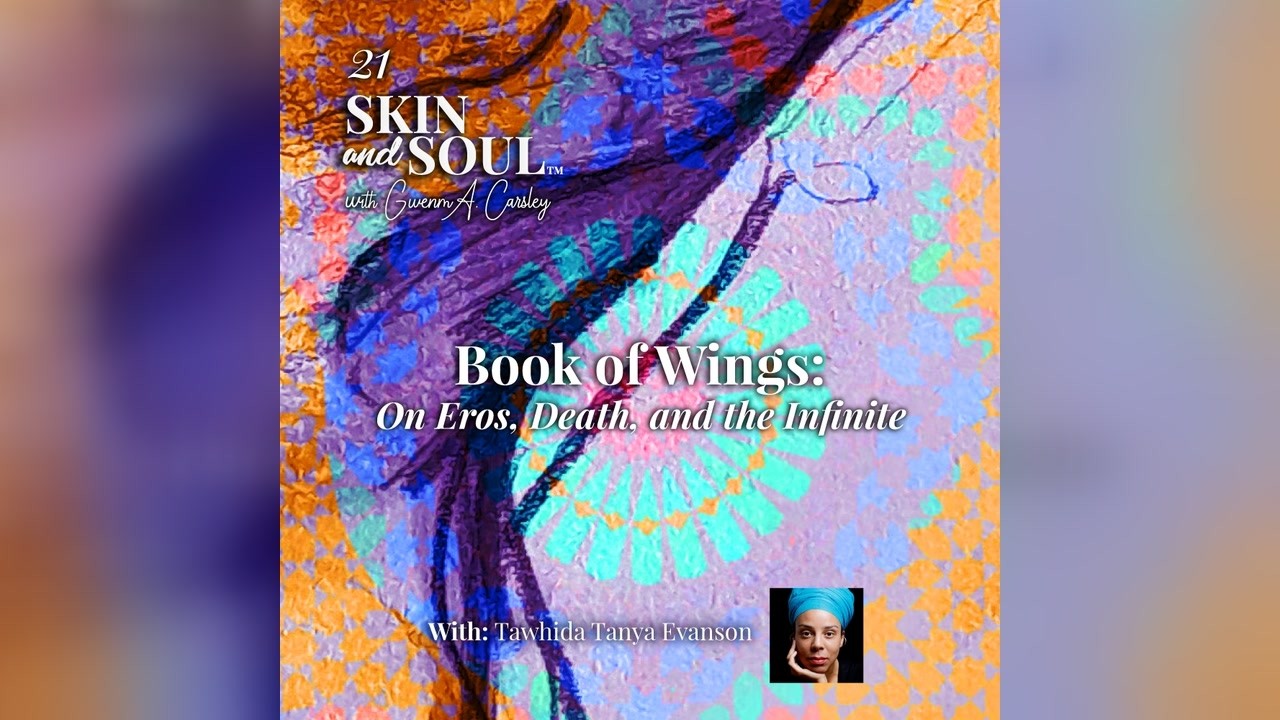
0:00 Welcome to Skin and Soul. I'm Gwenm Carsley, a Transformational Body, Sex and Soul Coach, and I'm inviting you on a bold, unfiltered journey into the heart of our humanity through the lens of Eros. This is where we strip away the shame, dive into the unspoken, and embrace the wild, raw truth of our desires. Together, we'll crack open the taboo, uncover our deepest intimacies, and awaken the pulse of our sexual essence. Because real transformation, it's messy, it's thrilling, and it's oh so delicious. Buckle up, loves. Skin and Soul Beyond the Pale starts in 3, 2, 1. Let's go.
0:46 Welcome back to Skin and Soul. I'm Gwenm. I'm your host of Skin and Soul on Transformation Talk Radio. And I'm here today, joined by a woman whose work doesn't just speak, it moves, it breathes, it sings. She is Eros as prayer and walking her talk. Tawheida Tanya Evanson is an acclaimed poet, novelist, and sound artist whose voice bridges continents, cultures, and dimensions. She is a whirling dervish, an ashik, I hope I said that right, a student of Sufism, a powerful force in the world of spoken word and ritual performance.
1:28 Her novel, which I absolutely adore, Book of Wings, is lyrically, a poetic, a lyrically, excuse me, a lyrically poetic journey through heartbreak, diaspora, and spiritual transformation. She's also the visionary behind award-winning films and recordings and sacred spaces, like her Afrofuturistic concert film, Cyano Sun Suite, which has won over 50 international awards. So whether through language, movement or vibration, her work holds the sacred, the erotic, and the political all in one breath. And I am so fortunate to have her here. She is someone that I have known, I'm going to say since childhood, since teenagehood, but definitely spanning 30, at least 30 years of connection.
2:16 And as I told you, I have no idea how I came to your book. I don't know, it just landed literally in front of me one day. And I don't know, I think I even had to look it up to go, is this who I think it is? And could not put it down and actually had to put it away when I got to Portugal. Locked it away because I didn't want to finish it because I was just like, I want to live in this world a little bit longer.
2:42 And so kind of put it aside for months at a time and then ended up reading it and then rereading it and now just listening to it. So I can't say enough good things about your work. I wanted to just talk to you about poetics and poeticism. So I'm going to dive right in. Knowing you from, I'm going to say teenagehood and I, you know, from recollection, what I said was that I already knew that you were a writer. And I didn't know that you were a poet, a poet per se, but I knew that like this wild woman lived in you.
3:20 I mean, that was, that was obvious. I know you got your hair back today, keeping it back, but, you know, knowing that wildness within you. So just wondering whether the poetry has always lived in you and when it started to emerge. Well, first of all, it's great to see you again, Gwenm. And yeah, we've known each other. We met in high school because we went to high school together and yeah, it's wonderful to be here. Thank you so much for inviting me. I'm glad you enjoyed Book of Wings. It was a joy to write.
3:56 It's something that I wrote about 20 years ago and I sat on the manuscript for a long time unsure as to what it was. And then someone, a friend of mine who is a poet and an author as well, a novelist, spoke to his editor and said, you should, you should talk to Tanya. She's sitting on a manuscript because I had shown it to him like 10 years before. And so an editor contacted me and said, I heard you have a manuscript that is, you know, about a journey in France and Morocco and I'd like to see it.
4:32 But first of all, I'm going on a trip to Morocco. So when I'm back, then I want to see your manuscript. So anyway, that was really cool. That was meant to be. But poetry started way before that. Actually, when around the time when we were in high school together, when I was 14 years old, I was having a really rough time. Inside myself, you know, hormones of hormones aside, of course, hormones are a big part of the difficulties that teenagers go through. But I felt that my thoughts were really convoluted and I couldn't see them clearly.
5:06 I couldn't understand myself or life itself clearly. And I attempted suicide. So I ended up in the hospital. And, you know, luckily I failed and I will never try. That again, because that's an experience I could say I have lived through. So I'm very lucky to have lived through it and to be able to, in fact, live the fruits of that experience. When I was in the hospital after the suicide attempt, someone from our class came to the hospital and brought me a journal. And that's when I started writing poetry and poetry saved me and it continues to save me today.
5:50 So that's how things started was looking at a blank page. And it can be two things. You know, we were speaking about this a little bit earlier. A blank page can be two things. It can be a space where you just put all your imagination. You can world build. You can crumple up the page and throw it away. You can draw on it. You can spit on it. It doesn't matter. You can bleed on it. It doesn't matter. Or you can create worlds and places that you've never been to.
6:22 And it can also be a mirror where you can express everything that's going on inside you in order to see it clearly. And in my case, not only did it allow me to see myself, but then I could mythologize myself. I could reshape things. I could give them shape, a beautiful shape that could come out of suffering. And yeah, it allowed me to see the beauty even in the shit. Mm-hmm. I don't know. They even like so love just even looking around the ideas around love and grief and loss that they become.
7:02 I love the word mythologize and it doesn't dilute the experience. In fact, it makes it such a beautifully human felt experience and shifts the perspective. And having gone through the suicide attempt, which I'm going to thank you so much for saying it out loud, because I think it's really it's courageous to say it. And it's also, I think, something that so many people live through, including this one and the survival of it. I'm wondering how how you appreciate life differently in since then. And how it has informed your poetry and actually like if you still have that first poem.
7:45 I don't know. I have early work. I still have some early work, but I don't know if I have the first poem per se, because I don't have that journal anymore. But I did keep subsequent journals and I did. I do have a stack of journals that I've kept throughout my life. And I would say in terms of the value of life, you know, when we wake up in the morning, it's not guaranteed. So when you wake up, you should wake up and say, thank you for giving me another day.
8:18 And it's up to you what you do with that day. But the fact that you are alive is because you're a miracle. Right. One one million sperm out of one million sperm or even more. I'm not sure how many millions of sperm one hit that egg and it's you. So don't take that for granted. You know, each of us is a miracle and we have to kind of arrive with that. And if we have been given more than we need, then we need to pass it on.
8:47 We need to pass it on and see that clearly. You know, we live in a culture, especially here in Canada. And I know you not sure if we're allowed to say where you are, but we are in Western nations. OK, yeah. Yeah. So in Germany, Canada, clearly I'm on. Yes. I'm where I I'm in front of some crystal pyramids. So it's an alternate Giza. Yeah, we we normalize wealth and we shouldn't. So I understand the importance of of earning a living, but we normalize more than we need.
9:27 So having more than we need. So and complain about things that we shouldn't be complaining about when we we miss the point of things, which is to be in service to each other. Like, yeah, that's what we're here for. There's no other reason to all be here. Else I'd have my own planet and you'd have your own planet and we wouldn't have to pay taxes. We wouldn't even need language like we, you know. So there's a reason we're all in this this blue ball together. Yeah.
9:52 No pun intended. No. Right. Oh, gosh. Yeah. You know, something you're going to know about me. It can take me a week to get the joke. And then I'm like, oh, that's funny. Which is interesting to me because I actually feel like everybody deserves to be wealthy. I'm like I'm on the opposite end of the spectrum. We were talking about artists and I, you know, having lived as an actor and really, I mean, trying to get by to the next moment sometimes and waiting for the next gig and whatever it was and living that kind of a life.
10:28 And oftentimes, and you were saying that like artists that have a lot to say are often coming from places that that are difficult, that they're in survival mode, that that sometimes a lot of the time great art actually emerges from those places. And I'm like, oh, the need to shine brighter, the need to like that, that we need this more in our lives, that there is there is this infinite space on what I feel in this in this world, in this being that we keep trying to squash each other rather than stepping into everyone's light, like allowing everyone's light, that there is room for it all instead of needing to squash it and and be in competition of it.
11:13 And to be in. I'm going to. I was thinking of just respecting the diversity of perspectives of this world, as opposed to. Yeah, just needing to have one one voice, be the voice, the dominant voice and just allowing for that play that to me is is the art. And this is to me what the fundamentals of Eros is, right? It's like this living life force that has to speak, that has something to say, but that's also constantly in communion, which is then going to bring me to what you do or being a whirling dervish, which I had not.
11:53 I just hadn't registered it before, so I definitely want to hear more around that. And then I do want to dive in also into Book of Wings, but if you can just express what it is to live as a whirling dervish. Well, Sufi whirling is a part of Sufi practice. It's just a public part of Sufi practice. There's many different Sufi orders that have a variety of practices around meditation, around chanting prayers, different kinds of activities, different kinds of rituals and ceremonies. But Sufi, first of all, Sufism is a combination of like shamanism and Islam.
12:37 So it's like the mystical essence of Islam. This is a very simplified way of describing it. And Sufi whirling is just the most public face of it, mainly because it's used as something to attract tourists in Turkey in particular, where it's mostly well known as having come as a Turkish cultural, as part of Turkish culture. And actually Sufism is illegal in Turkey, but only Sufi whirling is allowed to be shown in public and is appreciated and shared with the world as part of Turkish cultural tradition.
13:20 So with Sufism set aside. So that's… So interesting that it's cut it off, right? Okay. That's a whole other story. But the main thing is what is Sufi whirling? Sufi whirling, it's a turning meditation or a meditation in motion where you turn without spotting, you know, ballet dancers spot, but there's no spotting in this turning meditation. It's based on listening. It's known as sema or sama or sami, even in Arabic, which means listening. So it's a listening meditation. The idea is that you listen to music and you let it turn you, which is what we do when we go to a club and dance or go to a concert.
14:00 You don't dance against the music, you dance with it. And then when everyone is in it together, that's unity, right? If you've ever been to like a concert and everyone is like, everyone is, you can see that all the people in unison. This is a direct experience of unity or like a collective meditation. And whirling dervishes will all do the same motion while listening to the same music as an expression of the solar system. So it's got a whole mythology around poetry and the cosmos and quantum mechanics.
14:36 And it's a very complex and also very simple move because anyone can turn in a circle. I mean, kids turn in a circle. It's not something you need to learn. There is technique when it comes to the ceremony and specific practices within that ceremony. But all kids turn. It's just about remembering how to do it. So, yeah, we're I'm very lucky. I hold a space here in Jojaga in Montreal, where once a month it's anyone who wants to come and try this practice can come. And it's also part of our private practice, but it's we open it to anyone and we have like kind of a warm up and then we take the first steps together and then musicians come and then we don't even know what happened.
15:24 So it's very cool to bring people into ritual, especially folks in the westernized world who have forgotten what ritual is. And you don't need to say much. You just need to provide a safe space for people to remember. It's like, well, when you think of being a child, like you said, it's so it's it's within ourselves right under the clouds. Right. Just think about spinning and looking up. And when we used to do that until we toppled over, usually giggling, right, completely dizzy from staring up at the clouds and how beautiful that is.
16:02 So in that we were talking about the practice of a death ceremony, because I just want to transition it totally. To that, because I think that's so interesting that celebrating the death of Rumi and opening up the door through the dance. Yeah, Sufi whirling is very complex. There's a lot to say about it, but there is an annual there's an annual ceremony called Sheb Yarus. It means the wedding night, and it's to celebrate the passing of Mevlana Rumi, who is a poet who lived about 800 years ago, actually 752 years ago, because we're celebrating the 752nd anniversary of his passing.
16:46 And the idea is that when you die, it is the ultimate union, the ultimate union with the divine or with God or with all that is or with infinite consciousness, however you define it. However you define the force, for example, in Star Wars terms, I think everyone can take that as a baseline. So it's the it's your wedding night with all that is. And that's what we celebrate once a year. It's the the source celebration is in Turkey and Konya where where Rumi lived and also where his his mausoleum is.
17:30 But it's it's celebrated all over the world and we're celebrating it here in Georgia, Montreal in December as well. It's celebrated across North America, across Europe, Australia, some Asian countries, even some African countries. So it's a very powerful, let's say, gratitude. It's a ceremony of gratitude. And the idea is not not to not to weep when someone passes away because it's, you know, they are released from the prison of the body. So it's something to also celebrate that you are completely free and you are completely uncontained and unlimited.
18:15 So this relationship with death, which I find is really interesting because I another person that that I am acquainted with is a death doula, which I also find incredibly interesting to witness people cross over into another realm. And so I think one of my curiosity is are that whether you. How you step in with the divine, like how you pass that threshold for yourself, because even like going back to in childhood and experiencing like, you know, nearly taking one's own life and then coming into communion with death, both as a stripping of egos.
18:57 Right. So we talk about death and stripping the ego and coming, stripping ourselves down to our barest bones. But then also what's your experience of just being with all that is? Well, I mean, when you sneeze or have an orgasm, you are with all that is like that is a sweet spot. So we have those experiences every day and we don't even think about it. You can have them intentionally. You can seek them out intentionally. This idea of union or this sensation of being unlimited. We have it when we're dreaming. We don't feel our bodies when we're dreaming.
19:29 We're in another world. We can have it in our imagination and then we can have it in these spiritual practices such as meditation or Sufi whirling, which is an active meditation. You can have it through psychedelics. You can have it with alcohol. Right. You can have moments where you are dissolved. You have disappeared in plain sight. So these are ways. But also you could speak with with shamans who also have these experiences of, let's say, shape shifting or being in two places at once or levitating or.
20:02 So there's many ways and we use very little of our brain. So if you ponder just the fact that we use so little of our brain that we might have superpowers that are dormant, those superpowers allow us to cross these thresholds into basically what it is to go beyond death and then also to come back and tell the story. So some people who have had near death experiences also have these have these moments, too. But the question is, do you believe them or do you perhaps need the direct experience, which is very similar to meditation?
20:39 When people talk about meditation, you can't really talk about it. You have to do it. It's experiential. So these experiences are that you have to undergo them directly in order to have any notion at all about them. In order for you to believe that they're true. So if you've sat in meditation and didn't have a body when you were sitting motionless, then you have had this experience of what it is to be uncontained, unlimited, uncontained by your your body. So a lot of us have these experiences already, but we pass them over because nobody wants to pay attention to death.
21:20 Nobody wants to face that. We want to live while we're alive, but it's two sides of one coin. So the artist will do the work or the shaman will do the work that folks don't want to do, which is that level of self reflection and self realization and exploring other universes that are available to us. You know, there's all of these universes that are available to the human being are not available to all the animals. You know, even though we the animals might dream, they can't tell us about it. So, yeah, we have access to things.
21:57 And if our animal self is only concerned with eat, don't get eaten, reproduce. And, you know, OK, you've got food in the fridge. You don't have to worry about eating. No one's really going to come and eat you unless you are in a survival mode. So technically, you probably don't have a predator. So that's done. So all you're left with is sex. OK, you can play in that world. You can deal with that world, take care of it through masturbation or however way you need to take care of that.
22:32 And then you are free to explore the other universes, to think about other things. That's where I like to play. And that's a privilege to be able to play there. Yeah, I'm wondering if and I don't know if this is your experience. It's just I find when I'm writing or when I'm in a very creative place, I tend to dance when I when I when I write. I'm constantly in movement. And from what I've been told for anyone who's ever witnessed my writing is like my whole body is involved.
23:04 My expressions, whatever is going on, it's moving very literally through my body. And I love that the both the connection of the divine, the experience of like entering into other realms. And I always I always experience it as even in connection with someone else, like there's a knowing. I feel like there's an energetic there are energetic threads that are that I grab onto here or there. And it's literally almost for me, the experience is having images that then get translated through words is how it kind of moves through me.
23:39 And in the lovemaking, you know, we were talking earlier around the flesh and the divine and our bodies, and I and I've had these, you know, not too frequently in my life, but definitely had it with my wife. And then and then since in my journey over the last 10, 15 years or so of being able to be in the body while then expanding outside of it. So just completely being feeling feeling the range of motion of emotion. So we're talking about, you know, feeling grief over here or even worse, like that that place of numbness of where there's nothing and then feeling the extremities on the other end and playing.
24:23 So. In that realm in the flesh. And so I don't know if there's a question around this, just like the only way my own curiosity around like so when you're writing, when you're when you're dancing, when you're when you're singing or you're having spoken word is how that takes over into your your your your body, your being. Well, the first thing I would say is even the word dervish means threshold. So the idea is to that you are always in both worlds. You know, we have our inner world and then we have this outside world.
24:58 So in fact, we're always there depends on how much we we think about it. And then our inner world also can be the inner world of the biology of the inner world, but it can also be the philosophy and the psychology of the inner world, you know, and then there's the physicality of the outer world as well. So there's all of these things that we're always trying to bring balance into when it comes to writing. My writing style is actually I'm always speaking out loud. And I actually wanted to tell you this quote that I found from Ted Jones.
25:30 And it's about. OK, it's about. Saying things out loud that most people are afraid of. So there's a this poet Ted Jones, he was a beat poet, a black beat poet in the States in the 60s. And later on in his life, he came to live in Vancouver. And so I got to spend time with him when I was living in Vancouver as well before he passed away. And his quote is, if you should see a man, let's say a human walking down a crowded street, talking aloud to himself, to themselves, don't run in the opposite direction, but run towards them.
26:12 For they are a poet and you have nothing to fear from a poet, but the truth. So this is a very a quote that when I heard him say this, I was like, oh, there I am, because that's how I write. I write in speaking. And then. So, you know, I'm here. I have a writing studio and I'm very lucky. I just cross the hall every day and I go to work. It's really wonderful. But when I'm in this space, I'm either doing logistics or admin or I'm doing I'm working on new creations or editing or.
26:46 But my way of writing is to say things out loud and to hear them. And if my ears hear them and I have a reaction, like an emotional reaction, then I catch them and I write them down. So that's actually my writing process. So I have other processes as well, like other prompts that I might use. Right now I'm using my dreams as stories because our dreams are nightly psychedelic experiences. So I'm using those as stories and also doing a lot of work around dream studies and sleep and consciousness and.
27:26 And lucid dreaming. So that's a specific type of work that can involve epiphany. But as a poet, epiphany is all about something that just arrives like falling in love. It's not a choice. It's not logical. It's just a verdict. And there's nothing you can do about it. You can try and run away, but you cannot outrun it. So my work is more, yeah, it's more, more along the lines of epiphany and then editing the epiphanies so that they can, they, they work together as a, as a whole, as a group.
28:03 So either in, you know, stanzas, poems, chapters, a book altogether. So, and I've just been writing a book now that is over 300 pages of gossels. Gossels are couplets. And the, they, it's just been coming out that way where I'm, it's being said through me. And I, and if my ears hear it and it has power, then I put it on the page. And then later on I go in and edit, but I've been editing very little because it's been, they've been very powerful. I'm having some powerful experiences.
28:37 So the writing is powerful and I'm just letting it be that. It doesn't mean that I'm not applying logic, the editor's eye and the logic of that, but it does come out as epiphany. And for me, that's the most beautiful kind of poetry. Yeah. I was going to say, so is this your, is this the second volume to Book of Wings or is this something separate? It's a second volume, but in Book of Wings is a novel and this is going to be a book of gossels.
29:04 Like it's, they are specific, it's a specific form. So, yeah, so we'll see, but I'm also working on a book of short stories around dreams. So we'll see also what that's going to be. And they're both being written simultaneously. So, but then I also just put out a film last year. So I'm not always sure what the work wants to be. I just try to get out of the way to let it be what it wants to be. And that is a great privilege and a great honor.
29:29 And it also means that I have resources and access to funding in the arts around me to allow this kind of freedom and liberation in an arts practice. And it means I can be a griot, like fully my griot multimedia artist self, which is what a griot is in the West African tradition. An artist with 50 job titles. I think all artists are 50 job titles. You know, you have to be like, if you were a dancer, that's what you were. You were a dancer. If you were an actress, that was what you were.
29:59 And I, and I think part of the beauty now is like, forget the titles. And again, you know, like saying earlier, like, oh, you know, and that, that applies to me personally, in terms of like defining who I am. I'm like, oh, yeah, there's a list. There's a, you know, the writer, the producer, the this or that. Like, it's like, it's ridiculous. It's like after a while, it's like whatever wants to emerge. And in this I have like, okay, so I have a bunch of curiosities.
30:23 One is because, and we talked about menopause a little bit. Like I've passed that threshold and kind of like super grateful that I have because I thought it would be a nightmare. And it would mean that the death of being a woman in the sense of like all of my passion and the creativity, the lusciousness, the juiciness. And I was like terrified of it. And now I'm like, it's pretty good. This is great. I don't really have to worry about a couple of things. And, and just, you know, growing older from that space and where you are today.
30:59 Sorry, I totally lost my train of thought and where I was going with it. But I was talking about lucid dreaming because I found that my somewhere from, and we talked about my wife had passed away and somewhere in, in the journey, I was in deep sleep and very lucid dreaming, like in constant kind of connection with the other world. And then, as I came back into my body, I'm going to say, my, I, I, I stopped having this capacity for dreaming. And it's just starting to come back, but I'm not, I'm not able to access those spaces too easily, mostly because my, my sleep gets so interrupted, which I think is a menopausal thing.
31:41 But anyway, so I wanted to talk a little bit around like your work around the lucid dreaming and the dreaming and, hanging on to your dreams. Like how, how do you consciously in the dream state stay with the dream? These are loaded questions, all of them. And wonderful. You only have five minutes to answer that. No, I'm kidding. Well, one is, I started writing my dreams when I was very young and I remember because I had a recurring dream and I, and yeah, I was writing them, but I didn't know what the value was.
32:19 I had almost, I had maybe 20 or 30 years of dreams and I didn't know what their value was. I, they were just dream vignettes that I'd written. And I just sat on that manuscript as well for a long time. and then when I took it down, I started looking at it and I had exactly 108 dreams. So I thought, okay, what does this mean? I don't know. Let me just start doing a little bit of research into dreams. And I found out that the first Onero critic, manuscript, which is like the first dream dictionary has exactly 108 dreams in ancient Egypt.
32:54 I mean, now it's in the, you know, the museum of London, but I was like, okay, there's something to this. There's a reason I have exactly 108 dreams and I'm getting these signs. And after that, a lot of other signs came too, but I was in the same boat as you where I hadn't accessed my dreams in like 10 years, mainly not from menopause because I'm still waiting for menopause to have. And hopefully she'll come gently. But I was waking up earlier and earlier when a lot of the dreams tend to happen in that sweet spot around four and 7 AM.
33:26 And if you are an adult and getting on in years, you, we tend to wake up earlier and earlier and earlier. It's like, my mom's like, I was up at 4.30 as I am every day. I'm like, why are you up at 4.30? Well, that's also not wasting the day. And in bed at 7, though. Right? In bed at 7. But you know what? That's also being with daylight hours, not wasting any time, not wasting the day, especially as we start to notice, okay, I have less time.
33:53 Once you hit middle age, then, you know, your immortal self goes, oh man, I think I am mortal. At least this body is mortal. So then you don't want to waste any time in the body, the container you've been given with the life you've been given and you want to make the most of it. But I couldn't access my dreams like you. And then I met someone who has, who created a supplement that aids in vivid dream recall and also supports lucid dreaming, which requires a practice.
34:24 So I started taking these supplements. We did some experiments together as well around lucid dreaming, but I started taking his supplements and I started a lucid dreaming practice. And by studying Tibetan dream yoga, which is lucid dreaming also, by the way, means being awake inside your dreams. So knowing that you are dreaming, but being aware and conscious and therefore able to control and direct your dreams and have agency in them. And you could decide where you want to go, what you want to do, who you want to be.
34:59 It's very powerful and very rare. Some people have it a little more easily than others, but it is a practice. So I started taking these supplements and I started this lucid dreaming practice. And at the end of two weeks, I had my first lucid dream. And then I really started recalling my dreams and I started getting back into dream journaling, which is what you want to do when you're, you don't remember your dreams. You might want to consider different herbal products to aid in dream recall.
35:27 Blue Lotus, Egyptian Blue Lotus. There's African Dream Root. And then my friend's company, Ancestral Magi, but it's not available in Canada, but it might be available to you in Germany. And there's a lucid dreaming supplement called Mang and it's very powerful. It's a mild psychoactive, but it's very, it was very useful in helping me get back into having an active dream life that I could recall upon waking. And one of the first things you want to do when you do wake up, when you start to hear sound, which means you're back in the room, you're not in the dream world, is you don't move.
36:01 If you don't move, once you are, you know, you're in like a liminal state, you're in an in-between state between waking and between dreaming and waking. So you want to not move and go over your dream, review it, and then immediately write it down or what I prefer to do, which is dictate to text on my phone. Yeah. I dictate the dream right away. So that's going to, and also even going to bed saying, I will remember my dream. I will remember my dream. You know, there's practices you can do to get back into it, regardless of when you wake up, because you do dream through all your dream, all your sleep cycles, whether it's light or deep or REM.
36:39 So you're always dreaming. It's more about how can you engage with some practices that will help you stay there and explore that world more because there's so much to explore there in however way you want to explore it. Well, I usually love staying in a dream when I'm, when I'm in a dream space. I do recognize how much I enjoy being in the space and that I don't want to quite let it go. And then realizing when I wake up that none of it made sense, right?
37:07 Like that the imagery itself sometimes eludes me. And so that's, that's a practice to go back to, but I, yeah. But the imagery can be different. Imagery can be different depending on who you are. You can open up a dream dictionary. I mean, this first, this ancient, this Kemetic dream book, it had 108 dreams, but they were all for people from that region. So they all perhaps had a similar set of symbols that made sense to them. You know, if you are living in, you know, if you're, if you're Peruvian or if you're Filipino, or you might have a different set of symbols.
37:43 So a dream, a standard dream dictionary may not be useful for you, but you don't necessarily have to interpret your dreams as symbols. You can look at them as stories and what is that story telling me, regardless of what each symbol or image within the story is trying to tell me. What does the story as a whole tell me? What I noticed in my dreams is that my sister was in every one of my dreams. I didn't even realize she was always there. I'm like, how come I didn't realize this before?
38:09 But the dream practice helped me to see that and to, to remember her importance in my life. That's very cool. Because what I've noticed is how little people are in my dreams or how, like for my son, for instance, it's very, very rare for my son to be in my dreams. And I think there's, there has been a fear around it so that I have, I think I've had one or two dreams and they're usually in a fear base, but it's, it's taken a lifetime to, to go, wow.
38:38 Like the people that are in my life, like my wife, I never dreamt about my wife ever while I was with her. It was only after we separated and, and, and since she passed that I have dreams of her really frequently. and actually sense her in a way. I mean, I sense her in my waking, right? I, I, I, as I said earlier is that she's very much part of my daily ritual of just talking to someone that I feel like I've got an ally in this life and can hear those words in my head sometimes.
39:11 yeah. Yeah. So yeah, that's, that's super interesting to me to, to travel that world. And I'm going to pick your brain more about those supplements. I think. Yeah. She was your waking dream. She was my waking dream. Yeah. And, you know, we were talking again earlier around love and stuff. And, and I was saying how, you know, I think I'm really fortunate that I have, I have that, like I have, I've, I've, I've experienced two great loves in my life and I don't really need anything anymore.
39:42 and whatever happens, it doesn't mean I don't want to journey with someone. I absolutely want to journey with someone. Like, I mean, this life to me is, I don't, I don't think that we're meant to, to travel it alone. Like I don't, I don't, I don't have that like martyr dome, but I do feel that we need to be somewhat whole inside. Like that there's this place of fulfillment within that, like I said, you know, where, what was it that you said? You said, Oh, I've had, I used to have like lover.
40:11 It was like either I'm in love with you and we don't have it, you know, and I agree. I don't think we have a choice around who we love. I think how we act in, in love is a different thing. There's absolutely conscious choice, but that drawing of absolutely abandonment of love, is, is that, that choice is like far deeper. Yeah. That we don't understand. and I mean, there's, there's loving kindness and then there's falling in love. Loving kindness is a choice. Like that's like our human duty to just be kind to each other.
40:43 Be that's like also a very Buddhist tenant, you know, to just loving kindness, but to fall in love. It just happens to you. It's not something you choose. It's something that occurs to you. And then, as you said, it's up to you what you do with that experience. Mm-hmm. So I'm going to ask, cause I know we don't have that much time left. So is Shams the first love, the greatest love? Shams is the only love. And actually Shams is, the reason that the, the, this character in the Book of Wings is named Shams is because there's a whole mythology around this, person named Shamsi Tabrizi, who was Rumi's.
41:27 teacher, the poet Rumi. And the, so that, it's said that a lot of Rumi's writing, came only when Shams left. So, and, and then what was that experience of joy and longing and sorrow, and then ultimately God. So in this separation, then you, you discover that, yeah, you yourself are divine. Mm-hmm. And that it's, yeah. So it's a, there's a reason why I use that name, but it's interesting because the word sham in English means like someone who plays a trick on you. Yeah. Right. It's a, it's like a, it's a scam artist.
42:09 It's a, a trickster. So it's very interesting that that's what it means in English. whereas it's coming from Persian, like Shams is coming from, actually it's an Arabic. It's used in, in, in the Arab world as well, but that name comes from this, this person who lived a thousand years ago or 800 years ago that, yeah. And then, who was Rumi's teacher and then, but sometimes the one that changes you is so bright that the world can't see them. So we needed someone like Rumi, who was more like the moon that we can actually look at to get, to find out what the sun is about because we can't look directly at the sun.
42:51 So Shams is this symbol of the sun and Shams also means sun in, in, in Persian and in Arabic. There's a lot of mythology around that character. yeah. And that's why, that's why they're, they're called that. But I've had four loves in my life. Like I've, I've been in love four times. So, but you, I think once you're in love the first time, you're never really out of love. Like you're kind of in the ocean and you're just, you just keep swimming and other people might come and swim beside you.
43:22 But if you're really in it, especially in the Sufi tradition, those of us who are not. those of us who are, initiates in the Sufi tradition often color, call ourselves Ashiks or lovers of God. And yeah, because you are a lover with a capital L. Yeah. I think I can relate to that, even not being in the tradition that there's something within that. I just, I say I'm in love with life. Like there's, there's, there's something within that is just alive and in love. And then absolutely there are, are whether, you know, call it a soulmate.
43:58 I'm, I will call it a soul lover, a soul love. Absolutely. That I have, I I've had this, I've had three soul loves or like I have my third soul love, which I feel is my, my, I hate to use the word ultimate. I think that that's like such a bad word to use, but that there's this, deep resonance at this time, which actually feels closer to age and wisdom and growing into a place of being so good in the love of it. And not having to give myself away for validation or seeking the love outside or, or needing something else other than like knowing that being with someone brings a journey onto its own.
44:43 And just like in this playground that we call life. Right. But, that the love is it's bound and weaved in a way that's just, yeah, it's there. and it's alive. So it's also tied to your maturity level, which is not what it used to be and always changing. So that's why you're experiencing it this way. It's, it's because of your, your, the station that you're at now. And it's, it's beautiful to know that you can even go from station to station. You know, some people don't even know there's like a train or that there's like a platform.
45:18 And, and I, and I'm not talking about like a hierarchy of things that go up, but like more like a vast plane. Mm-hmm. And you're at your station and you might have an experience, could be a life experience, could be a near death experience, could be meeting someone, having some great big emotional event. Mm-hmm . And it takes you on a train to the next station. It's not that it's better or worse. And you are different. You are changed by it. And it's wonderful to have those experiences and to get on the train and to just go.
45:50 You don't know where it's going to go, but you'll be different when you get to the other, to the next station. If you decide to even get off at the next station. If you decide. Right. And I, you know, when I used to say to my therapist was like, as, as I was in kind of, my own awakening, I'm going to call it crisis, hell, beauty, ecstasy was all of it. It was so intense. And I just kept seeing the train coming and I kept telling her, I just, I just want to stop the train.
46:15 Like, how do I stop the train? And today I know there was never a stopping of the train, right? Like that train is coming, whether we like it or not. And it's whether we get on it, whether we stay on it, whether we watch it go by us, whatever it is. but to recognize that the train is a really beautiful, opportunity to go journeying. so before I move into, cause I'm aware of time, unfortunately, and there is always so much to cover. I have my, my, my lovely 10 questions, which I don't have memorized, although you might.
46:53 so let me just fill this. And I'm going to ask you, so first of all, is there anything else that you want to add? I mean, we kind of skimmed over a book of wings, which I'm just going to encourage everybody to go and read. Cause it's, it's such a beautiful, beautiful novel. And I, I so look forward to the next, the next 300 pages. I just, yeah. and okay. I will ask this and then feel free to be okay. What is one truth your body has always known, has always known that your mind took years to catch up to?
47:34 When throughout my life, since I was a teenager, I've had skin problems. I've had, problems with acne. And when I was in my early forties, I went to, I went to the doctor and I said, am I going to have pimples forever? What's happening here? And the doctor said, well, you're detoxing through your largest organs. So it's actually really healthy and shows you perhaps foods that you're eating in that you shouldn't eat. Imagine most people detox within their organs and that's how they get sick because all the toxins stay in the organs and yours are going out through your largest organ.
48:18 And then finally my mind caught up to what my body was doing and I was able to accept that I'd had skin problems and what the benefit was of that and how it could help me clean up my diet, but also just accept myself. Thank you. What is the most intimate moment you've ever had that had nothing to do with sex? Yeah. Sufi practices are very intimate and they have nothing to do with sex, but perhaps you could say sex with God. so, and I can't talk about those, those need to be experienced directly.
49:01 So I did have a very beautiful embrace with someone that was, we were both standing and it was embraced that an embrace that wasn't, you're not locked in, but it's very kind of smooth and moving. And you're always kind of moving closer and apart, closer and apart without actually, releasing from the embrace. And it's, it was the longest and the most, intimate experience I've had with someone outside of sex, with a human being outside of sex that I can remember in recent history. Beautiful. Thank you.
49:37 Thank you. And if you could be remembered for one sensation you gave someone, what would it be? If I could make someone feel like they are dissolving, like they are, not contained by their body, that they are just merged with everyone, with everything, like disappeared almost. Mm-hmm. But through a quality of union, from the work that I do or from the words that I say, then I would be very happy to know that I could kind of be, like dissolve someone like sugar in water. Mm. Mission already accomplished.
50:28 And if pleasure were a language, what would your first word be? La. The word la, which means no in Arabic. Mm. And yet we sing that so often, don't we? La la la la. Exactly. It has many meanings. So yeah, it's a musical note, but it also means no. If your erotic life had a title, like a novel or a film, maybe both, what would it be called? Multiple. Hmm. That's a safe word. That's the safe word. What's one thing you've never said out loud, but you wish someone would ask you about?
51:22 Oh, I say everything out loud. Already. That's too late. It's too late for this oral poet. It's just too late for me. I love that. Okay. So what part of your erotic self are you still afraid to bring to the light? it, it feels all pretty much lit, but it, it's not. But it, things also get lit with the right partner. You know, you can light things up by yourself. You can burn alone, but why waste all that light? Mm-hmm. So it depends on the connection and vulnerability of the partner.
52:07 There are certain things I would like to explore, but I'm waiting for the partner to arrive to explore them with me. And if not, then I'll explore them by myself, but it is wasted light. I agree. It's not, I don't know if it's a way, I mean, for me. Yeah. I don't know if it's a wasted light, but yes, it's like I said, there's, there's something around the shared experience and that vulnerable, vulnerability is meant to be witnessed. It is not, it's not meant to live alone as is intimacy.
52:37 I mean, we have intimacy with ourselves and with God or the divine, however you want to put it. first and foremost. And yeah, having intimacy with another creature being in, in another flesh is a whole other incredible experience. Mm-hmm. All right. So what dies in you when you pretend? I think at this point, I mean, as an artist, I'm observing the pretendarians. Mm-hmm. but also I'm just too old to pretend and I care too much, which also means that I give zero fucks when it comes to bullshit.
53:19 Just I care too much. Can't wait to see you when you're 80. I just, like I said, I'm witnessing my mother with no filter. I'm like, Oh God. And it's kind of scared me because all of a sudden, I don't know if you have this experience in being alone right now. and the more time that I'm alone, the more, I'm witnessing my own filter disappear because there's just, I talk to myself now. I mean, and I'm, I'm a person who, when I write, I truly write from the head.
53:47 Like I hear the voice and then it comes through my hands, but it's suddenly coming out through the voice and I'm like, Oh, okay. Maybe we need to filter that out just a little bit, just a wee bit. Yeah. I mean, yeah. Well, also you speak according to what, to the ears that are listening. Not every ear needs to get the same thing from you. So that's also your, you filter according to the ears. Otherwise you care. You, you, you arrive at everything from, from compassion and empathy.
54:16 That's the goal. Anyways, that's the goal always. So then what comes alive in you when you don't? When I don't pretend. Mm-hmm. Life itself. Beautiful. So finish this sentence. When I leave this life, I want my skin to remember. Well, my skin won't matter though, when I'm dead, right? Right. They'll be like, Oh, I can just go back and maybe I can be a skin graft for someone else. Or, I can just go back and feed the soil and bring forth some flowers for those that I love who are still alive.
54:58 you know, when my father was dying and my father passed recently, he said that his body, it's not that he said this, but his body no longer served him. And he knew it because he was a medical doctor. And at one point he said, can you bring my legs closer to me? because he knew that his body and his skin also, none of it was useful to him anymore. And the skin is just one illusion that is like a separation between us and the outside world.
55:26 so I'll be happy when there's no illusion anymore, no separation, but I know that affection is important while we're alive, which is why, even if you're a monk, you're going to want to touch a cat. You know, you'll still enjoy the body as a playground and a temple and make choices so that everything is balanced. But once I'm gone, I won't need it. I don't need my skin to remember anything because my consciousness is going to be with the collective. It's going to be with the air that you breathe.
56:00 So I'm, I'm happy more for that. And the skin will have done its job. And I'm very thankful for it to have done its job. Yeah. Which, which I loved your explanation because in talking earlier about a death doula and watching some people give up their last breath with ease while others fight their way through. And I have a horrible suspicion. I'm a fighter, but, I'm, I'm already witnessing. You have this sense of like the last release is just the release of, of joining a collective, which is beautiful.
56:36 Or joining the one, you know, the, the one thing that cannot be named. Exactly. So if soul has a scent, what does yours smell like today? when I think of soul, I think of, that we all have the same soul, one soul. And that is God. That is my understanding of God. So it doesn't really have anything to do with the senses, but there's a scent that I have experienced recently. And it's a combination of a person's skin and the cologne that they wear. And that to me, had the scent of God.
57:26 And so it was skin and the cologne is fierce. Mm. Beautiful. Thank you. Oh, thank you for joining me. We've made it right to the end. And there's so much I wanted to do, including I have, I have a whole list of quotes, by the way, which I just, I'll have to send them to you. And there's like so many more that absolutely made me dissolve. since, you know, and brought me in, yeah, into my own energetic space. So thank you. Thank you for joining us today.
57:57 is there any place that anyone who wants to reach out, know more where they can go? yes, first of all, thank you so much, for inviting me to speak and to, to be in conversation with you. If people are interested in my work, they can go to mothertonguemedia.com. So mothertonguemedia.com. And all my work is there. My films, books, albums, live performances. it's all there. Beautiful. Thank you. And same. If you'd like to reach out and know more about what I do as a body, sex and soul coach, you can go to gwenmcarsley.com or reach out to me at info at Loovology.com.
58:42 Have a beautiful day, night, wherever you are and let poetry infiltrate you. Thank you for listening to skin and soul with me. Join me Fridays at 10 AM PST on transformation. Talk radio. Catch the podcast. Anytime on your favorite platforms. You can follow me on Instagram at Loovology. Ready to take the next step. Book a compatibility call with me at gwenmcarsley.com. Thanks for listening to Malik Malik Malik Malik Malik Malik Malik Malik Malik Malik Malik Malik Malik Malik Malik Malik Malik Malik Malik Malik Malik Malik Malik Malik Malik Malik Malik Malik Malik Malik Malik Malik Malik Malik Malik Malik Malik Malik Malik Malik Malik Malik Malik Malik Malik Malik Malik Malik Malik Malik Malik Malik Malik Malik Malik Malik Malik Malik Malik Malik Malik Malik Malik Malik Malik Malik Malik Malik Malik Malik Malik Malik Malik Malik Malik Malik Malik Malik Malik Malik Malik Malik Malik Malik Malik Malik Malik Malik Malik Malik Malik Malik Malik Malik Malik Malik Malik Malik Malik Malik Malik Malik Malik Malik Malik Malik Malik Malik Mal